Skip to main content
Trigonometry
나의 코스
배우기
시험 준비
AI 튜터
학습 가이드
교과서적 해결책
플래시카드
탐험해 보세요
앱을 사용해 보세요
나의 코스
배우기
시험 준비
AI 튜터
학습 가이드
교과서적 해결책
플래시카드
탐험해 보세요
앱을 사용해 보세요
뒤로
Trigonometry: Angles and Their Properties
카드를 뒤집기 위해 탭할 수 있습니다.
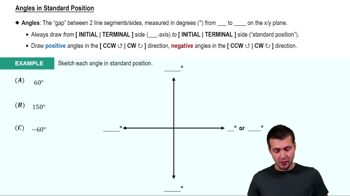
What is an angle in standard position?
카드를 뒤집기 위해 탭할 수 있습니다.
👆
What is an angle in standard position?
An angle with its vertex at the origin, initial side on the positive x-axis, and terminal side rotated from the initial side.
진행 상황 추적
컨트롤 버튼이 '내비게이션' 모드로 변경되었습니다.
1/20
추천 영상
VideoThumbView.guidedCourse
3:59
Example 1
1609
views
33
rank
VideoThumbView.guidedCourse
05:50
Drawing Angles in Standard Position
2692
views
76
rank
이 집합의 용어 (20)
하이드의 정의
What is an angle in standard position?
An angle with its vertex at the origin, initial side on the positive x-axis, and terminal side rotated from the initial side.
How is the measure of an angle in standard position determined?
By the amount of rotation from the initial side to the terminal side, measured in degrees or radians.
What are the four types of angles based on their measure?
Acute
(less than 90°),
Right
(exactly 90°),
Obtuse
(between 90° and 180°), and
Straight
(exactly 180°).
Define complementary angles.
Two angles whose measures add up to \(90^\circ\).
Define supplementary angles.
Two angles whose measures add up to \(180^\circ\).
What is the complement of a 30° angle?
60°, because 30° + 60° = 90°.
What is the supplement of a 110° angle?
70°, because 110° + 70° = 180°.
How do you find the complement of an angle \(x\)?
Subtract the angle from 90°, i.e., \(90^\circ - x\).
How do you find the supplement of an angle \(x\)?
Subtract the angle from 180°, i.e., \(180^\circ - x\).
What is the sum of the interior angles of a triangle?
Always \(180^\circ\).
How can complementary and supplementary angles help solve triangle problems?
They help find unknown angles by using the relationships that angles add up to 90° or 180°.
What is a radian?
A radian is a measure of angle based on the radius of a circle; one radian is the angle subtended by an arc equal in length to the radius.
How many radians are in a full circle?
A full circle is \(2\pi\) radians.
How many degrees are in a full circle?
A full circle is 360 degrees.
What is the formula to convert degrees to radians?
Multiply degrees by \(\frac{\pi}{180}\\).
What is the formula to convert radians to degrees?
Multiply radians by \(\frac{180}{\pi}\\).
Convert 120° to radians.
120° × \(\frac{\pi}{180}\\) = \(\frac{2\pi}{3}\\) radians.
Convert \(\frac{\pi}{5}\\) radians to degrees.
\(\frac{\pi}{5}\\) × \(\frac{180}{\pi}\\) = 36°.
What is the relationship between the initial side and terminal side in an angle in standard position?
The initial side lies on the positive x-axis; the terminal side is the rotated ray that forms the angle.
What is the difference between acute and obtuse angles?
Acute angles measure less than 90°, while obtuse angles measure more than 90° but less than 180°.
 뒤로뒤로
뒤로뒤로
 3:59
3:59