
교과서 질문
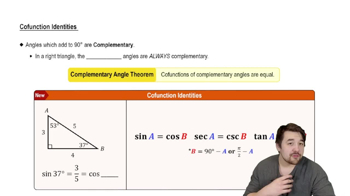
In Exercises 28–29, find a cofunction with the same value as the given expression. sin 70°
786
views

 검증된 단계별 안내
 6:30
6:30
 5:08
5:08 06:11
06:11In Exercises 28–29, find a cofunction with the same value as the given expression. sin 70°
In Exercises 25–30, use an identity to find the value of each expression. Do not use a calculator. sec² 23° - tan² 23°
In Exercises 30–32, find the measure of the side of the right triangle whose length is designated by a lowercase letter. Round answers to the nearest whole number.
In Exercises 23–34, find the exact value of each of the remaining trigonometric functions of θ. tan θ = -2/3, sin θ > 0
In Exercises 29–34, convert each angle in degrees to radians. Round to two decimal places. 18°
In Exercises 25–32, the unit circle has been divided into eight equal arcs, corresponding to t-values of 0, 𝜋, 𝜋, 3𝜋, 𝜋, 5𝜋, 3𝜋, 7𝜋, and 2𝜋. 4 2 4 4 2 4 a. Use the (x,y) coordinates in the figure to find the value of the trigonometric function. b. Use periodic properties and your answer from part (a) to find the value of the same trigonometric function at the indicated real number.
tan 𝜋