Ch. 1 - Angles and the Trigonometric Functions
1์žฅ, ๋ฌธ์ œ 4a

Find a positive angle less than 2๐œ‹ that is coterminal with 16๐œ‹ 3

๊ฒ€์ฆ๋œ ๋‹จ๊ณ„๋ณ„ ์•ˆ๋‚ด
1
Understand that two angles are coterminal if they differ by an integer multiple of \(2\pi\). This means we can add or subtract \(2\pi\) any number of times to find coterminal angles.
Given the angle \(\frac{16\pi}{3}\), we want to find an angle \(\theta\) such that \(0 < \theta < 2\pi\) and \(\theta = \frac{16\pi}{3} - 2\pi k\) for some integer \(k\).
Express \(2\pi\) with a denominator of 3 to combine terms easily: \(2\pi = \frac{6\pi}{3}\). So, \(\theta = \frac{16\pi}{3} - k \times \frac{6\pi}{3} = \frac{16\pi - 6\pi k}{3}\).
Find the integer \(k\) such that \(\theta\) lies between 0 and \(2\pi\) (i.e., \(0 < \theta < \frac{6\pi}{3}\)). This involves solving inequalities for \(k\).
Once you find the appropriate \(k\), substitute back to get \(\theta = \frac{16\pi - 6\pi k}{3}\), which will be the positive coterminal angle less than \(2\pi\).

๋น„์Šทํ•œ ๋ฌธ์ œ์— ๋Œ€ํ•œ ๊ฒ€์ฆ๋œ ์˜์ƒ ๋‹ต๋ณ€:

์ด ์˜์ƒ ํ•ด๋ฒ•์€ ์œ„ ๋ฌธ์ œ์— ๋„์›€์ด ๋œ๋‹ค๊ณ  ํŠœํ„ฐ๋“ค์ด ์ถ”์ฒœํ•œ ๊ฒƒ์ž…๋‹ˆ๋‹ค.
์˜์ƒ ๊ธธ์ด:
2m
๋„์›€์ด ๋˜์—ˆ๋‚˜์š”?

์ฃผ์š” ๊ฐœ๋…

์งˆ๋ฌธ์— ์˜ฌ๋ฐ”๋ฅด๊ฒŒ ๋‹ตํ•˜๊ธฐ ์œ„ํ•ด ๋ฐ˜๋“œ์‹œ ์ดํ•ดํ•ด์•ผ ํ•˜๋Š” ํ•ต์‹ฌ ๊ฐœ๋…๋“ค์€ ๋‹ค์Œ๊ณผ ๊ฐ™์Šต๋‹ˆ๋‹ค.

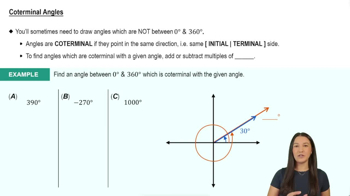
Coterminal Angles

Coterminal angles are angles that share the same initial and terminal sides but differ by full rotations of 2ฯ€ radians. To find a coterminal angle, you add or subtract multiples of 2ฯ€ until the angle lies within the desired interval.
์ถ”์ฒœ ์˜์ƒ:
04:46
Coterminal Angles

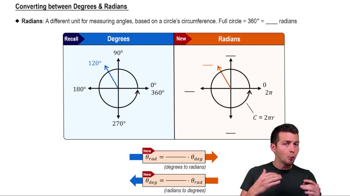
Angle Measurement in Radians

Angles can be measured in radians, where 2ฯ€ radians equal one full rotation (360 degrees). Understanding radian measure is essential for working with trigonometric functions and converting between angles.
์ถ”์ฒœ ์˜์ƒ:
5:04
Converting between Degrees & Radians

Modulo Operation with Angles

Finding an angle coterminal within a specific range involves using the modulo operation with 2ฯ€. This process reduces any angle to an equivalent angle between 0 and 2ฯ€ by subtracting multiples of 2ฯ€.
์ถ”์ฒœ ์˜์ƒ:
04:12
Algebraic Operations on Vectors