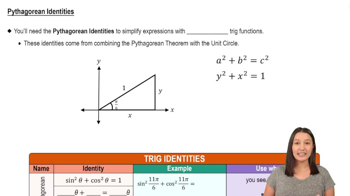
In Exercises 17–20, θ is an acute angle and sin θ and cos θ are given. Use identities to find tan θ, csc θ, sec θ, and cot θ. Where necessary, rationalize denominators.
__
sin θ = 6, cos θ = √13
7 7
검증된 단계별 안내
1
Step 1: Recall the identity for tangent: \( \tan \theta = \frac{\sin \theta}{\cos \theta} \). Substitute the given values: \( \tan \theta = \frac{\frac{6}{7}}{\frac{\sqrt{13}}{7}} \).
Step 2: Simplify the expression for \( \tan \theta \) by multiplying the numerator and the denominator by 7 to eliminate the fraction: \( \tan \theta = \frac{6}{\sqrt{13}} \).
Step 3: Rationalize the denominator of \( \tan \theta \) by multiplying the numerator and the denominator by \( \sqrt{13} \): \( \tan \theta = \frac{6\sqrt{13}}{13} \).
Step 4: Use the reciprocal identities to find \( \csc \theta \) and \( \sec \theta \): \( \csc \theta = \frac{1}{\sin \theta} = \frac{7}{6} \) and \( \sec \theta = \frac{1}{\cos \theta} = \frac{7}{\sqrt{13}} \).
Step 5: Rationalize the denominator for \( \sec \theta \) by multiplying the numerator and the denominator by \( \sqrt{13} \): \( \sec \theta = \frac{7\sqrt{13}}{13} \). Use the reciprocal identity for cotangent: \( \cot \theta = \frac{1}{\tan \theta} = \frac{\sqrt{13}}{6} \).
비슷한 문제에 대한 검증된 영상 답변:
이 영상 해법은 위 문제에 도움이 된다고 튜터들이 추천한 것입니다.
영상 길이:
4m
영상 재생:
0 댓글
주요 개념
질문에 올바르게 답하기 위해 반드시 이해해야 하는 핵심 개념들은 다음과 같습니다.
Trigonometric Ratios
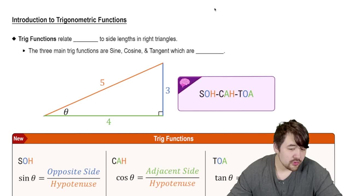
Trigonometric ratios are relationships between the angles and sides of a right triangle. The primary ratios include sine (sin), cosine (cos), and tangent (tan), defined as sin θ = opposite/hypotenuse, cos θ = adjacent/hypotenuse, and tan θ = opposite/adjacent. Understanding these ratios is essential for deriving other trigonometric functions and solving problems involving angles.
Reciprocal identities relate the primary trigonometric functions to their reciprocals. For example, cosecant (csc) is the reciprocal of sine, secant (sec) is the reciprocal of cosine, and cotangent (cot) is the reciprocal of tangent. These identities are crucial for finding additional trigonometric values when given sin θ and cos θ, as they allow for straightforward calculations.
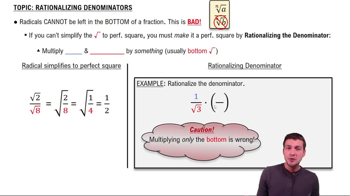
Rationalizing the denominator is a technique used to eliminate radicals from the denominator of a fraction. This is achieved by multiplying the numerator and denominator by a suitable value that will result in a rational number in the denominator. This process is often required in trigonometry to simplify expressions and ensure that the final answers are presented in a standard form.


 검증된 단계별 안내
 6:04
6:04