Ch. 1 - Angles and the Trigonometric Functions
Blitzer - Trigonometry 3rd Edition
Blitzer3rd EditionTrigonometryISBN: 9780137316601당신이 사용하는 게 아니라요?교과서 변경
1장, 문제 45

In Exercises 35–60, find the reference angle for each angle.
-150°

검증된 단계별 안내
1
Identify the quadrant in which the angle -150° lies. Since the angle is negative, measure it clockwise from the positive x-axis. -150° corresponds to rotating 150° clockwise, which places the terminal side in the third quadrant.
Recall that the reference angle is the acute angle formed between the terminal side of the given angle and the x-axis. For angles in the third quadrant, the reference angle is found by subtracting 180° from the angle if the angle is positive, or by subtracting the absolute value of the angle from 180° if the angle is negative.
Calculate the reference angle using the formula for negative angles in the third quadrant: Reference angle = 180° - |angle|. Substitute the given angle: Reference angle = 180° - 150°.
Simplify the expression to find the measure of the reference angle in degrees, which will be an acute angle between 0° and 90°.
Express the reference angle as a positive acute angle, which represents the smallest angle between the terminal side of the given angle and the x-axis.

비슷한 문제에 대한 검증된 영상 답변:

이 영상 해법은 위 문제에 도움이 된다고 튜터들이 추천한 것입니다.
영상 길이:
2m
도움이 되었나요?

주요 개념

질문에 올바르게 답하기 위해 반드시 이해해야 하는 핵심 개념들은 다음과 같습니다.

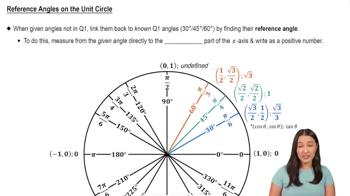
Reference Angle

A reference angle is the acute angle formed between the terminal side of a given angle and the x-axis. It is always positive and less than or equal to 90°, used to simplify trigonometric calculations by relating any angle to its acute counterpart.
추천 영상:
5:31
Reference Angles on the Unit Circle

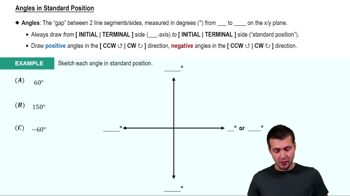
Standard Position of an Angle

An angle in standard position has its vertex at the origin and its initial side along the positive x-axis. Understanding this helps determine the quadrant in which the terminal side lies, which is essential for finding the correct reference angle.
추천 영상:
05:50
Drawing Angles in Standard Position

Quadrants and Angle Measures

The coordinate plane is divided into four quadrants, each corresponding to a range of angle measures. Knowing the quadrant of an angle (e.g., -150° lies in the third quadrant when converted to positive measure) helps in calculating the reference angle by subtracting from the nearest x-axis angle.
추천 영상:
6:36
Quadratic Formula