Ch. 1 - Angles and the Trigonometric Functions
Blitzer - Trigonometry 3rd Edition
Blitzer3rd EditionTrigonometryISBN: 9780137316601당신이 사용하는 게 아니라요?교과서 변경
1장, 문제 49

In Exercises 41–56, use the circle shown in the rectangular coordinate system to draw each angle in standard position. State the quadrant in which the angle lies. When an angle's measure is given in radians, work the exercise without converting to degrees.
Circle in rectangular coordinates for measuring angles in standard position.
16𝜋/3

검증된 단계별 안내
1
Step 1: Understand that the angle is given in radians as \(\frac{16\pi}{3}\). Since one full rotation around the circle is \(2\pi\) radians, we need to find the equivalent angle between \(0\) and \(2\pi\) by subtracting multiples of \(2\pi\).
Step 2: Calculate how many full rotations are contained in \(\frac{16\pi}{3}\) by dividing \(\frac{16\pi}{3}\) by \(2\pi\): \(\frac{16\pi}{3} \div 2\pi = \frac{16}{3} \times \frac{1}{2} = \frac{8}{3}\). This means the angle makes \(2\) full rotations (since \(\frac{8}{3} = 2 + \frac{2}{3}\)) plus an extra \(\frac{2}{3}\) of a rotation.
Step 3: Find the remaining angle after subtracting \(2\) full rotations: \(\frac{16\pi}{3} - 2 \times 2\pi = \frac{16\pi}{3} - 4\pi = \frac{16\pi}{3} - \frac{12\pi}{3} = \frac{4\pi}{3}\). This is the angle in standard position between \(0\) and \(2\pi\).
Step 4: Determine the quadrant of the angle \(\frac{4\pi}{3}\). Since \(\pi < \frac{4\pi}{3} < \frac{3\pi}{2}\), the angle lies in the third quadrant.
Step 5: To draw the angle, start from the positive x-axis and rotate counterclockwise by \(\frac{4\pi}{3}\) radians, which is \(240^\circ\) (though we do not convert to degrees for the problem). Mark the terminal side of the angle in the third quadrant on the circle.

비슷한 문제에 대한 검증된 영상 답변:

이 영상 해법은 위 문제에 도움이 된다고 튜터들이 추천한 것입니다.
영상 길이:
3m
도움이 되었나요?

주요 개념

질문에 올바르게 답하기 위해 반드시 이해해야 하는 핵심 개념들은 다음과 같습니다.

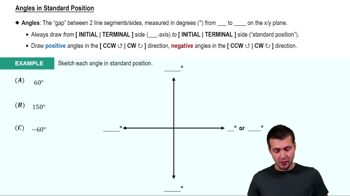
Angles in Standard Position

An angle is in standard position when its vertex is at the origin of the coordinate system and its initial side lies along the positive x-axis. The terminal side is determined by rotating the initial side counterclockwise for positive angles and clockwise for negative angles. Understanding this helps in accurately drawing and locating angles on the coordinate plane.
추천 영상:
05:50
Drawing Angles in Standard Position

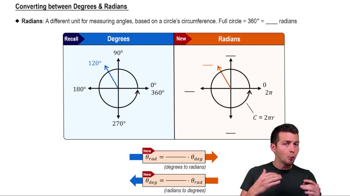
Radian Measure and Circle Rotation

Radians measure angles based on the radius of a circle, where one full rotation equals 2π radians. To work with angles larger than 2π, you subtract multiples of 2π to find the equivalent angle within one full rotation. This concept is essential for interpreting and drawing angles like 16π/3 without converting to degrees.
추천 영상:
5:04
Converting between Degrees & Radians

Quadrants of the Coordinate Plane

The coordinate plane is divided into four quadrants, each defined by the signs of x and y coordinates. Knowing which quadrant an angle's terminal side lies in helps describe its position and properties. This is crucial for identifying the quadrant of an angle drawn in standard position.
추천 영상:
6:36
Quadratic Formula