Ch. 2 - Graphs of the Trigonometric Functions; Inverse Trigonometric Functions
Blitzer - Trigonometry 3rd Edition
Blitzer3rd EditionTrigonometryISBN: 9780137316601당신이 사용하는 게 아니라요?교과서 변경
2장, 문제 46

Determine the amplitude, period, and phase shift of each function. Then graph one period of the function.
y = 4 cos(2x − π)

검증된 단계별 안내
1
Identify the general form of the cosine function: \(y = A \cos(Bx - C)\), where \(A\) is the amplitude, \(B\) affects the period, and \(C\) relates to the phase shift.
Find the amplitude by taking the absolute value of \(A\). For the function \(y = 4 \cos(2x - \pi)\), the amplitude is \(|4|\).
Calculate the period using the formula \(\text{Period} = \frac{2\pi}{|B|}\). Here, \(B = 2\), so substitute to find the period.
Determine the phase shift using the formula \(\text{Phase shift} = \frac{C}{B}\). Since the function is \(y = 4 \cos(2x - \pi)\), rewrite the inside as \(2x - \pi = 2(x - \frac{\pi}{2})\), so \(C = \pi\) and \(B = 2\).
To graph one period, start at the phase shift on the x-axis, then plot points over one full period length calculated in step 3, using the amplitude to mark maximum and minimum values of the cosine wave.

비슷한 문제에 대한 검증된 영상 답변:

이 영상 해법은 위 문제에 도움이 된다고 튜터들이 추천한 것입니다.
영상 길이:
7m
도움이 되었나요?

주요 개념

질문에 올바르게 답하기 위해 반드시 이해해야 하는 핵심 개념들은 다음과 같습니다.

Amplitude of a Trigonometric Function

Amplitude is the maximum absolute value of a trigonometric function, representing the height from the midline to the peak. For functions like y = a cos(bx + c), the amplitude is |a|. In the given function y = 4 cos(2x − π), the amplitude is 4, indicating the graph oscillates between -4 and 4.
추천 영상:
6:04
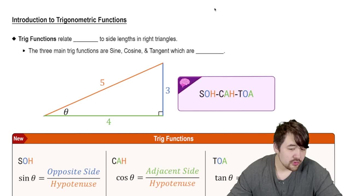
Introduction to Trigonometric Functions

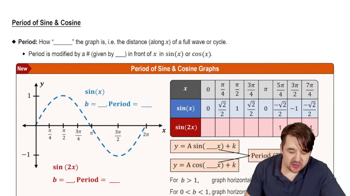
Period of a Trigonometric Function

The period is the length of one complete cycle of the function along the x-axis. For y = cos(bx + c), the period is calculated as (2π) / |b|. In y = 4 cos(2x − π), b = 2, so the period is π, meaning the function repeats every π units.
추천 영상:
5:33
Period of Sine and Cosine Functions

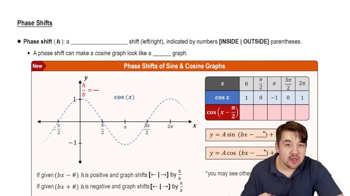
Phase Shift of a Trigonometric Function

Phase shift is the horizontal translation of the graph, determined by solving bx + c = 0 for x. It is given by -c/b. For y = 4 cos(2x − π), the phase shift is (π/2) units to the right, indicating the graph is shifted right by π/2 compared to the standard cosine function.
추천 영상:
6:31
Phase Shifts