Ch. 2 - Graphs of the Trigonometric Functions; Inverse Trigonometric Functions
Blitzer - Trigonometry 3rd Edition
Blitzer3rd EditionTrigonometryISBN: 9780137316601당신이 사용하는 게 아니라요?교과서 변경
2장, 문제 9

Find the exact value of each expression. cos⁻¹ (-√2/2)

검증된 단계별 안내
1
Recognize that the expression involves the inverse cosine function, written as \(\cos^{-1}(x)\), which gives the angle whose cosine is \(x\).
Identify the value inside the inverse cosine: \(-\frac{\sqrt{2}}{2}\). Recall that \(\cos(\theta) = -\frac{\sqrt{2}}{2}\) corresponds to specific angles on the unit circle.
Recall the reference angle where \(\cos(\theta) = \frac{\sqrt{2}}{2}\), which is \(\frac{\pi}{4}\) radians (or 45 degrees). Since the cosine is negative, the angle must be in either the second or third quadrant.
Since the range of \(\cos^{-1}(x)\) is \([0, \pi]\), the angle must be in the second quadrant. Therefore, the angle is \(\pi - \frac{\pi}{4}\).
Express the exact value of \(\cos^{-1} \left(-\frac{\sqrt{2}}{2}\right)\) as \(\pi - \frac{\pi}{4}\), which can be simplified further if needed.

비슷한 문제에 대한 검증된 영상 답변:

이 영상 해법은 위 문제에 도움이 된다고 튜터들이 추천한 것입니다.
영상 길이:
4m
도움이 되었나요?

주요 개념

질문에 올바르게 답하기 위해 반드시 이해해야 하는 핵심 개념들은 다음과 같습니다.

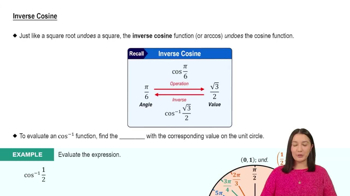
Inverse Cosine Function (cos⁻¹)

The inverse cosine function, denoted as cos⁻¹ or arccos, returns the angle whose cosine is a given value. Its range is limited to [0, π] radians (or [0°, 180°]) to ensure it is a function. Understanding this helps find the angle corresponding to a specific cosine value.
추천 영상:
4:49
Inverse Cosine

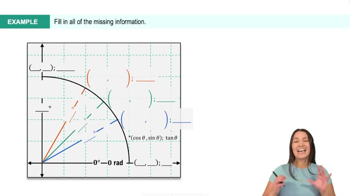
Exact Values of Cosine for Special Angles

Certain angles have well-known cosine values involving square roots, such as cos(45°) = √2/2. Recognizing these exact values allows you to identify angles without a calculator, which is essential for finding precise inverse trigonometric values.
추천 영상:
6:04
Example 1

Handling Negative Cosine Values

Cosine values can be negative depending on the quadrant of the angle. Since cos⁻¹ outputs angles in [0, π], negative cosine values correspond to angles in the second quadrant (between 90° and 180°). This knowledge helps determine the correct angle for negative inputs.
추천 영상:
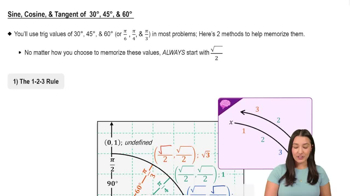
5:08
Sine, Cosine, & Tangent of 30°, 45°, & 60°