Ch. 2 - Graphs of the Trigonometric Functions; Inverse Trigonometric Functions
Blitzer - Trigonometry 3rd Edition
Blitzer3rd EditionTrigonometryISBN: 9780137316601당신이 사용하는 게 아니라요?교과서 변경
2장, 문제 23

In Exercises 1–26, find the exact value of each expression. _ csc⁻¹ (− 2√3/3)

검증된 단계별 안내
1
Recall that the function \( \csc^{-1}(x) \) is the inverse cosecant function, which gives an angle \( \theta \) such that \( \csc(\theta) = x \). Our goal is to find \( \theta \) where \( \csc(\theta) = -\frac{2\sqrt{3}}{3} \).
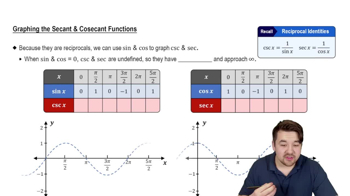
Use the identity relating cosecant and sine: \( \csc(\theta) = \frac{1}{\sin(\theta)} \). Therefore, \( \sin(\theta) = \frac{1}{\csc(\theta)} = \frac{1}{-\frac{2\sqrt{3}}{3}} = -\frac{3}{2\sqrt{3}} \).
Simplify the expression for \( \sin(\theta) \) by rationalizing the denominator: multiply numerator and denominator by \( \sqrt{3} \) to get \( \sin(\theta) = -\frac{3\sqrt{3}}{2 \times 3} = -\frac{\sqrt{3}}{2} \).
Determine the angle \( \theta \) whose sine is \( -\frac{\sqrt{3}}{2} \). Recall that \( \sin(\theta) = \pm \frac{\sqrt{3}}{2} \) corresponds to reference angles of \( \frac{\pi}{3} \) (or 60 degrees). Since the sine is negative, \( \theta \) must be in either the third or fourth quadrant.
Identify the principal value range for \( \csc^{-1}(x) \), which is usually \( [-\frac{\pi}{2}, 0) \cup (0, \frac{\pi}{2}] \) excluding zero. Find the angle \( \theta \) in this range with \( \sin(\theta) = -\frac{\sqrt{3}}{2} \).

비슷한 문제에 대한 검증된 영상 답변:

이 영상 해법은 위 문제에 도움이 된다고 튜터들이 추천한 것입니다.
영상 길이:
5m
도움이 되었나요?

주요 개념

질문에 올바르게 답하기 위해 반드시 이해해야 하는 핵심 개념들은 다음과 같습니다.

Inverse Cosecant Function (csc⁻¹)

The inverse cosecant function, csc⁻¹(x), returns the angle whose cosecant is x. It is the inverse of the cosecant function, which is defined as csc(θ) = 1/sin(θ). Understanding its domain and range is essential to find the correct angle corresponding to a given value.
추천 영상:
6:22
Graphs of Secant and Cosecant Functions

Relationship Between Cosecant and Sine

Cosecant is the reciprocal of sine, so csc(θ) = 1/sin(θ). To find an angle from a cosecant value, first find the sine value by taking the reciprocal. This relationship helps convert the problem into finding an angle from a sine value, which is more straightforward.
추천 영상:
6:22
Graphs of Secant and Cosecant Functions

Exact Values of Special Angles

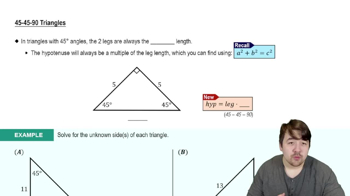
Certain angles have well-known exact sine and cosecant values, often involving √2, √3, and rational numbers. Recognizing these special angles (like 30°, 45°, 60° or π/6, π/4, π/3) allows you to identify the angle corresponding to the given cosecant value without a calculator.
추천 영상:
04:39
45-45-90 Triangles