Ch. 2 - Graphs of the Trigonometric Functions; Inverse Trigonometric Functions
Blitzer - Trigonometry 3rd Edition
Blitzer3rd EditionTrigonometryISBN: 9780137316601당신이 사용하는 게 아니라요?교과서 변경
2장, 문제 28

In Exercises 21–28, an object moves in simple harmonic motion described by the given equation, where t is measured in seconds and d in inches. In each exercise, find the following: a. the maximum displacement b. the frequency c. the time required for one cycle. d = −4 sin 3π/2 t

검증된 단계별 안내
1
Identify the given equation of motion: \(d = -4 \sin \left( \frac{3\pi}{2} t \right)\). Here, \(d\) represents displacement in inches, and \(t\) is time in seconds.
Determine the maximum displacement by finding the amplitude of the sine function. The amplitude is the absolute value of the coefficient in front of the sine, which is \(|-4|\).
Find the angular frequency \(\omega\) from the argument of the sine function. The argument is \(\frac{3\pi}{2} t\), so \(\omega = \frac{3\pi}{2}\) radians per second.
Calculate the frequency \(f\) using the relationship between angular frequency and frequency: \(f = \frac{\omega}{2\pi}\). Substitute \(\omega = \frac{3\pi}{2}\) to express \(f\) in hertz (cycles per second).
Find the time period \(T\), which is the time required for one complete cycle, using the formula \(T = \frac{1}{f}\). This gives the duration of one full oscillation.

비슷한 문제에 대한 검증된 영상 답변:

이 영상 해법은 위 문제에 도움이 된다고 튜터들이 추천한 것입니다.
영상 길이:
4m
도움이 되었나요?

주요 개념

질문에 올바르게 답하기 위해 반드시 이해해야 하는 핵심 개념들은 다음과 같습니다.

Simple Harmonic Motion (SHM)

Simple Harmonic Motion describes oscillatory motion where the displacement varies sinusoidally with time. The general form is d(t) = A sin(ωt) or d(t) = A cos(ωt), where A is the amplitude, ω is the angular frequency, and t is time. Understanding SHM helps interpret the given equation and extract motion characteristics.
추천 영상:
04:46
Products of Complex Numbers in Polar Form

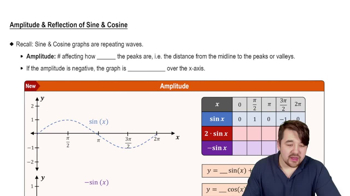
Amplitude and Maximum Displacement

Amplitude is the maximum distance an object moves from its equilibrium position in SHM. It corresponds to the coefficient before the sine or cosine function in the equation. In the given equation, the amplitude is 4 inches, indicating the maximum displacement the object reaches during its motion.
추천 영상:
5:05
Amplitude and Reflection of Sine and Cosine

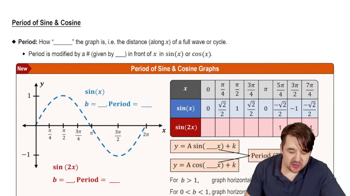
Frequency and Period of Oscillation

Frequency is the number of complete cycles per second, measured in hertz (Hz), and is related to angular frequency ω by f = ω/(2π). The period is the time for one full cycle, given by T = 1/f. These concepts allow calculation of how fast the object oscillates and the duration of each cycle from the equation's angular frequency.
추천 영상:
5:33
Period of Sine and Cosine Functions