In Exercises 21–28, an object moves in simple harmonic motion described by the given equation, where t is measured in seconds and d in inches. In each exercise, find the following: a. the maximum displacement b. the frequency c. the time required for one cycle. d = −4 sin 3π/2 t
Ch. 2 - Graphs of the Trigonometric Functions; Inverse Trigonometric Functions

모든 교과서
Blitzer 3rd Edition
Ch. 2 - Graphs of the Trigonometric Functions; Inverse Trigonometric Functions
문제 29
Blitzer 3rd Edition
Ch. 2 - Graphs of the Trigonometric Functions; Inverse Trigonometric Functions
문제 292장, 문제 29
In Exercises 27–38, use a calculator to find the value of each expression rounded to two decimal places. sin⁻¹ (-0.32)
검증된 단계별 안내1
Identify the function involved: here, \( \sin^{-1} \) represents the inverse sine function, also known as arcsine, which gives the angle whose sine is the given value.
Recall the domain and range of the inverse sine function: the input value must be between -1 and 1, and the output angle will be in the range \( [-\frac{\pi}{2}, \frac{\pi}{2}] \) or equivalently \( [-90^\circ, 90^\circ] \). Since -0.32 is within the domain, the calculation is valid.
Use a calculator set to the correct mode (degrees or radians depending on the problem context) to find \( \sin^{-1}(-0.32) \).
Input the value -0.32 into the inverse sine function on the calculator to get the angle whose sine is -0.32.
Round the resulting angle to two decimal places as required.

비슷한 문제에 대한 검증된 영상 답변:
이 영상 해법은 위 문제에 도움이 된다고 튜터들이 추천한 것입니다.
영상 길이:
1m도움이 되었나요?
주요 개념
질문에 올바르게 답하기 위해 반드시 이해해야 하는 핵심 개념들은 다음과 같습니다.
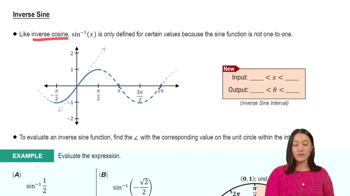
Inverse Sine Function (sin⁻¹ or arcsin)
The inverse sine function, denoted as sin⁻¹ or arcsin, returns the angle whose sine is a given number. It is defined for inputs between -1 and 1 and outputs angles typically in the range of -90° to 90° (or -π/2 to π/2 radians). Understanding this helps in finding the angle corresponding to a sine value.
추천 영상:
Inverse Sine
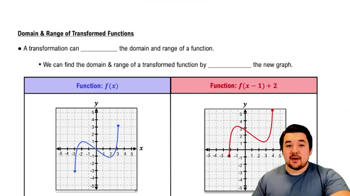
Domain and Range of the Inverse Sine Function
The domain of sin⁻¹ is limited to values between -1 and 1 because sine values cannot exceed this range. The range of sin⁻¹ is the set of possible output angles, usually from -90° to 90°. Recognizing these limits ensures the input is valid and the output angle is interpreted correctly.
추천 영상:
Domain and Range of Function Transformations
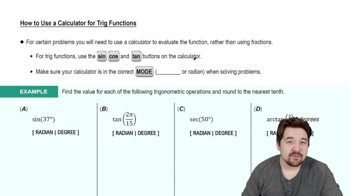
Using a Calculator to Evaluate Inverse Trigonometric Functions
Calculators have specific modes (degree or radian) that affect the output of inverse trig functions. To find sin⁻¹(-0.32), input the value correctly and ensure the calculator is set to the desired angle unit. Rounding the result to two decimal places provides a precise and usable answer.
추천 영상:
How to Use a Calculator for Trig Functions
관련 실천
교과서 질문
1160
views
교과서 질문
Graph two periods of the given cosecant or secant function.
y = 2 csc x
865
views
교과서 질문
In Exercises 29–44, graph two periods of the given cosecant or secant function. y = 3 csc x
1018
views
교과서 질문
In Exercises 17–30, determine the amplitude, period, and phase shift of each function. Then graph one period of the function. y = −2 sin(2πx + 4π)
561
views
교과서 질문
Use each graph to obtain the graph of the corresponding reciprocal function, cosecant or secant. Give the equation of the function for the graph that you obtain.
<IMAGE>
485
views
교과서 질문
In Exercises 29–36, find the length x to the nearest whole unit.
462
views