Ch. 2 - Graphs of the Trigonometric Functions; Inverse Trigonometric Functions
Blitzer - Trigonometry 3rd Edition
Blitzer3rd EditionTrigonometryISBN: 9780137316601당신이 사용하는 게 아니라요?교과서 변경
2장, 문제 33

In Exercises 29–36, find the length x to the nearest whole unit.
Right triangle with angles 37° and 72°, height 800, find length x.

검증된 단계별 안내
1
Identify the right triangle and the given information: the height (opposite side) is 800 units, and the angles adjacent to the base are 37° and 72°.
Recognize that the height of 800 is opposite to the 72° angle in the smaller right triangle formed inside the larger triangle.
Use the tangent function for the smaller triangle: \(\tan(72^\circ) = \frac{800}{\text{adjacent side}}\). Solve for the adjacent side, which is the segment of the base adjacent to the 72° angle.
Use the tangent function for the larger triangle: \(\tan(37^\circ) = \frac{800}{x + \text{adjacent side}}\). Here, \(x + \text{adjacent side}\) is the total base length of the larger triangle.
Solve the two tangent equations step-by-step to find the length \(x\), which is the segment of the base adjacent to the 37° angle.

비슷한 문제에 대한 검증된 영상 답변:

이 영상 해법은 위 문제에 도움이 된다고 튜터들이 추천한 것입니다.
영상 길이:
5m
도움이 되었나요?

주요 개념

질문에 올바르게 답하기 위해 반드시 이해해야 하는 핵심 개념들은 다음과 같습니다.

Right Triangle Trigonometry

Right triangle trigonometry involves relationships between the angles and sides of a right triangle. The primary trigonometric ratios—sine, cosine, and tangent—relate an angle to the ratios of two sides. These ratios are essential for finding unknown side lengths or angles when some measurements are given.
추천 영상:
04:39
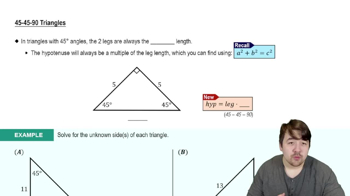
45-45-90 Triangles

Trigonometric Ratios (Sine, Cosine, Tangent)

Sine, cosine, and tangent are ratios defined for an acute angle in a right triangle: sine is opposite/hypotenuse, cosine is adjacent/hypotenuse, and tangent is opposite/adjacent. These ratios allow calculation of unknown sides or angles when at least one side length and one angle are known.
추천 영상:
5:08
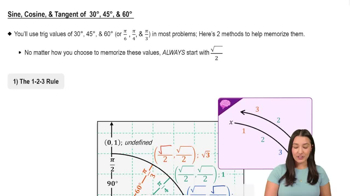
Sine, Cosine, & Tangent of 30°, 45°, & 60°

Angle Sum in a Triangle and Complementary Angles

The sum of angles in any triangle is 180°. In a right triangle, the two non-right angles are complementary, meaning they add up to 90°. This property helps identify missing angles and apply the correct trigonometric ratios to solve for unknown sides.
추천 영상:
3:35
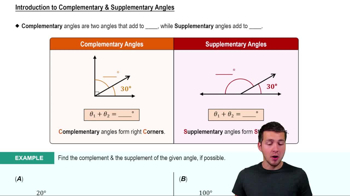
Intro to Complementary & Supplementary Angles