Ch. 2 - Graphs of the Trigonometric Functions; Inverse Trigonometric Functions
Blitzer - Trigonometry 3rd Edition
Blitzer3rd EditionTrigonometryISBN: 9780137316601당신이 사용하는 게 아니라요?교과서 변경
2장, 문제 47

In Exercises 45–52, graph two periods of each function. y = sec(2x + π/2) − 1

검증된 단계별 안내
1
Identify the given function: \(y = \sec(2x + \frac{\pi}{2}) - 1\). This is a secant function with a horizontal transformation inside the argument and a vertical shift downward by 1.
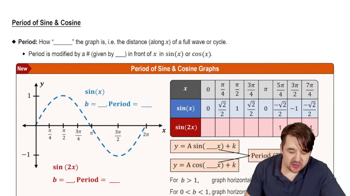
Determine the period of the function. The general period of \(\sec(bx)\) is \(\frac{2\pi}{|b|}\). Here, \(b = 2\), so the period is \(\frac{2\pi}{2} = \pi\).
Since the problem asks for two periods, calculate the interval length to graph: \(2 \times \pi = 2\pi\). So, you will graph the function over an interval of length \(2\pi\).
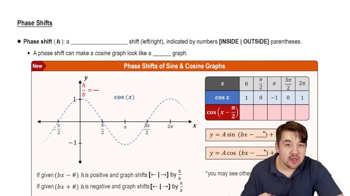
Find the phase shift caused by the \(+ \frac{\pi}{2}\) inside the argument. Solve \(2x + \frac{\pi}{2} = 0\) for \(x\) to find the horizontal shift: \(x = -\frac{\pi}{4}\). This means the graph is shifted left by \(\frac{\pi}{4}\).
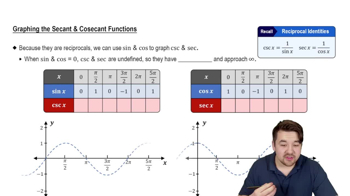
Identify key points and vertical asymptotes of the secant function by setting the inside of the secant equal to values where cosine is zero (since \(\sec \theta = \frac{1}{\cos \theta}\)). Solve \(2x + \frac{\pi}{2} = \frac{\pi}{2} + k\pi\) for \(x\) to find vertical asymptotes, then plot the graph accordingly over two periods, applying the vertical shift of \(-1\).

비슷한 문제에 대한 검증된 영상 답변:

이 영상 해법은 위 문제에 도움이 된다고 튜터들이 추천한 것입니다.
영상 길이:
7m
도움이 되었나요?

주요 개념

질문에 올바르게 답하기 위해 반드시 이해해야 하는 핵심 개념들은 다음과 같습니다.

Period of a Trigonometric Function

The period of a trigonometric function is the length of the interval over which the function completes one full cycle. For secant functions, the period is derived from the coefficient of x inside the function. Specifically, the period of y = sec(bx) is 2π/|b|, which determines how the graph repeats.
추천 영상:
5:33
Period of Sine and Cosine Functions

Phase Shift

Phase shift refers to the horizontal translation of the graph caused by adding or subtracting a constant inside the function's argument. For y = sec(2x + π/2), the phase shift is found by solving 2x + π/2 = 0, which shifts the graph left or right, affecting where key features like asymptotes and peaks occur.
추천 영상:
6:31
Phase Shifts

Graphing the Secant Function

The secant function is the reciprocal of cosine and has vertical asymptotes where cosine equals zero. When graphing y = sec(2x + π/2) − 1, identify asymptotes from the cosine zeros, plot key points from the cosine graph, and apply vertical shifts. Understanding these features helps accurately sketch two periods of the function.
추천 영상:
6:22
Graphs of Secant and Cosecant Functions