교과서 질문
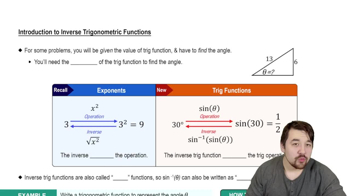
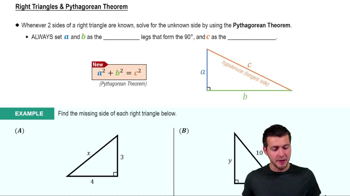
In Exercises 83–94, use a right triangle to write each expression as an algebraic expression. Assume that x is positive and that the given inverse trigonometric function is defined for the expression in x. sec (cos⁻¹ 1/x)
698
views

 Blitzer 3rd EditionCh. 2 - Graphs of the Trigonometric Functions; Inverse Trigonometric Functions문제 94
 검증된 단계별 안내
 4:28
4:28
 5:19
5:19 6:22
6:22In Exercises 83–94, use a right triangle to write each expression as an algebraic expression. Assume that x is positive and that the given inverse trigonometric function is defined for the expression in x. sec (cos⁻¹ 1/x)
The graphs of y = sin⁻¹ x, y = cos⁻¹ x, and y = tan⁻¹ x are shown in Table 2.8. In Exercises 97–106, use transformations (vertical shifts, horizontal shifts, reflections, stretching, or shrinking) of these graphs to graph each function. Then use interval notation to give the function's domain and range. f(x) = sin⁻¹ x + π/2
The graphs of y = sin⁻¹ x, y = cos⁻¹ x, and y = tan⁻¹ x are shown in Table 2.8. In Exercises 97–106, use transformations (vertical shifts, horizontal shifts, reflections, stretching, or shrinking) of these graphs to graph each function. Then use interval notation to give the function's domain and range. f(x) = cos⁻¹ (x + 1)
The graphs of y = sin⁻¹ x, y = cos⁻¹ x, and y = tan⁻¹ x are shown in Table 2.8. In Exercises 97–106, use transformations (vertical shifts, horizontal shifts, reflections, stretching, or shrinking) of these graphs to graph each function. Then use interval notation to give the function's domain and range. h(x) = −2 tan⁻¹ x
In Exercises 83–94, use a right triangle to write each expression as an algebraic expression. Assume that x is positive and that the given inverse trigonometric function is defined for the expression in x. ___ sec (sin⁻¹ x/√x²+4)
In Exercises 83–94, use a right triangle to write each expression as an algebraic expression. Assume that x is positive and that the given inverse trigonometric function is defined for the expression in x. cos (sin⁻¹ 1/x)