Ch. 3 - Trigonometric Identities and Equations
3์žฅ, ๋ฌธ์ œ 13

Solve each equation on the interval [0, 2๐…). Use exact values where possible or give approximate solutions correct to four decimal places. sin 2x + cos x = 0

๊ฒ€์ฆ๋œ ๋‹จ๊ณ„๋ณ„ ์•ˆ๋‚ด
1
Start by rewriting the given equation: \(\sin 2x + \cos x = 0\).
Use the double-angle identity for sine: \(\sin 2x = 2 \sin x \cos x\). Substitute this into the equation to get \(2 \sin x \cos x + \cos x = 0\).
Factor out the common term \(\cos x\): \(\cos x (2 \sin x + 1) = 0\).
Set each factor equal to zero and solve separately: 1) \(\cos x = 0\) 2) \(2 \sin x + 1 = 0\).
Solve each equation on the interval \([0, 2\pi)\): - For \(\cos x = 0\), find all \(x\) where cosine is zero. - For \(2 \sin x + 1 = 0\), isolate \(\sin x\) and find all \(x\) where sine equals that value.

๋น„์Šทํ•œ ๋ฌธ์ œ์— ๋Œ€ํ•œ ๊ฒ€์ฆ๋œ ์˜์ƒ ๋‹ต๋ณ€:

์ด ์˜์ƒ ํ•ด๋ฒ•์€ ์œ„ ๋ฌธ์ œ์— ๋„์›€์ด ๋œ๋‹ค๊ณ  ํŠœํ„ฐ๋“ค์ด ์ถ”์ฒœํ•œ ๊ฒƒ์ž…๋‹ˆ๋‹ค.
์˜์ƒ ๊ธธ์ด:
5m
๋„์›€์ด ๋˜์—ˆ๋‚˜์š”?

์ฃผ์š” ๊ฐœ๋…

์งˆ๋ฌธ์— ์˜ฌ๋ฐ”๋ฅด๊ฒŒ ๋‹ตํ•˜๊ธฐ ์œ„ํ•ด ๋ฐ˜๋“œ์‹œ ์ดํ•ดํ•ด์•ผ ํ•˜๋Š” ํ•ต์‹ฌ ๊ฐœ๋…๋“ค์€ ๋‹ค์Œ๊ณผ ๊ฐ™์Šต๋‹ˆ๋‹ค.

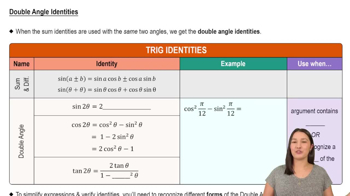
Double-Angle Identity for Sine

The double-angle identity expresses sin(2x) as 2 sin(x) cos(x). This allows rewriting the equation sin 2x + cos x = 0 in terms of sin(x) and cos(x), simplifying the solving process by reducing it to a single trigonometric function or a product of functions.
์ถ”์ฒœ ์˜์ƒ:
05:06
Double Angle Identities

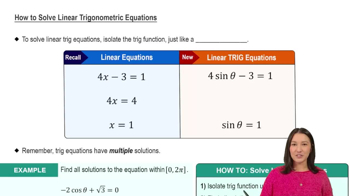
Solving Trigonometric Equations

Solving trigonometric equations involves isolating the trigonometric function and finding all angle solutions within the given interval. This often requires factoring, using identities, and considering the periodicity of sine and cosine to find all valid solutions between 0 and 2ฯ€.
์ถ”์ฒœ ์˜์ƒ:
4:34
How to Solve Linear Trigonometric Equations

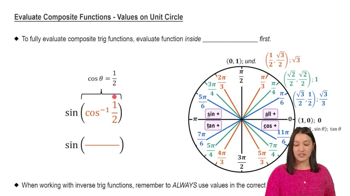
Interval Restriction and Exact Values

The problem restricts solutions to the interval [0, 2ฯ€), meaning only angles within one full rotation are considered. Solutions should be given as exact values (like ฯ€/3) or approximated to four decimal places, ensuring clarity and precision in the final answers.
์ถ”์ฒœ ์˜์ƒ:
5:10
Evaluate Composite Functions - Values on Unit Circle