Ch. 3 - Trigonometric Identities and Equations
Blitzer - Trigonometry 3rd Edition
Blitzer3rd EditionTrigonometryISBN: 9780137316601당신이 사용하는 게 아니라요?교과서 변경
3장, 문제 3.2.63a

In Exercises 57–64, find the exact value of the following under the given conditions:
a. cos (α + β)
tan α = 3/4, 𝝅 < α < 3𝝅/2, and cos β = 1/4, 3𝝅/2 < β < 2𝝅

검증된 단계별 안내
1
Identify the given information: \( \tan \alpha = \frac{3}{4} \) with \( \pi < \alpha < \frac{3\pi}{2} \), and \( \cos \beta = \frac{1}{4} \) with \( \frac{3\pi}{2} < \beta < 2\pi \).
Determine the signs of sine and cosine for angles \( \alpha \) and \( \beta \) based on their quadrant locations. Since \( \pi < \alpha < \frac{3\pi}{2} \), \( \alpha \) is in the third quadrant where sine and cosine are both negative. Since \( \frac{3\pi}{2} < \beta < 2\pi \), \( \beta \) is in the fourth quadrant where cosine is positive and sine is negative.
Use the identity \( \tan \alpha = \frac{\sin \alpha}{\cos \alpha} \) to find \( \sin \alpha \) and \( \cos \alpha \). Given \( \tan \alpha = \frac{3}{4} \), set \( \sin \alpha = 3k \) and \( \cos \alpha = 4k \) for some \( k \). Use the Pythagorean identity \( \sin^2 \alpha + \cos^2 \alpha = 1 \) to solve for \( k \), then apply the correct signs based on the quadrant.
Similarly, find \( \sin \beta \) using the Pythagorean identity \( \sin^2 \beta + \cos^2 \beta = 1 \) with \( \cos \beta = \frac{1}{4} \). Determine the sign of \( \sin \beta \) based on the quadrant of \( \beta \).
Apply the cosine addition formula: \( \cos(\alpha + \beta) = \cos \alpha \cos \beta - \sin \alpha \sin \beta \). Substitute the values of \( \cos \alpha \), \( \cos \beta \), \( \sin \alpha \), and \( \sin \beta \) found in previous steps to express \( \cos(\alpha + \beta) \) exactly.

비슷한 문제에 대한 검증된 영상 답변:

이 영상 해법은 위 문제에 도움이 된다고 튜터들이 추천한 것입니다.
영상 길이:
8m
도움이 되었나요?

주요 개념

질문에 올바르게 답하기 위해 반드시 이해해야 하는 핵심 개념들은 다음과 같습니다.

Sum of Angles Formula for Cosine

The sum of angles formula states that cos(α + β) = cos α cos β − sin α sin β. This identity allows you to find the cosine of the sum of two angles using the cosines and sines of the individual angles, which is essential for solving the problem.
추천 영상:
2:25
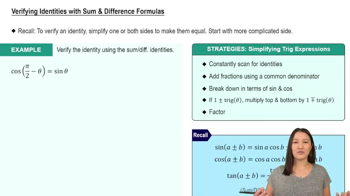
Verifying Identities with Sum and Difference Formulas

Determining Trigonometric Ratios from Given Conditions

Given tan α and the quadrant of α, you can find sin α and cos α by using the Pythagorean identity and the sign conventions of the quadrant. Similarly, knowing cos β and the quadrant of β helps determine sin β. This step is crucial to apply the sum formula correctly.
추천 영상:
6:08
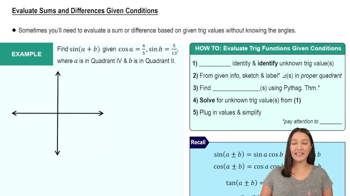
Evaluating Sums and Differences Given Conditions

Quadrant Sign Rules for Trigonometric Functions

The signs of sine, cosine, and tangent depend on the quadrant in which the angle lies. For example, in quadrant II, sine is positive and cosine is negative. Understanding these sign rules ensures accurate calculation of trigonometric values based on the given angle ranges.
추천 영상:
6:04
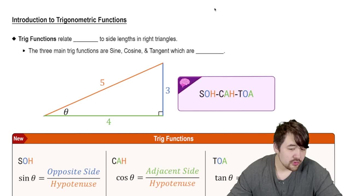
Introduction to Trigonometric Functions