Ch. 4 - Laws of Sines and Cosines; Vectors
Blitzer - Trigonometry 3rd Edition
Blitzer3rd EditionTrigonometryISBN: 9780137316601당신이 사용하는 게 아니라요?교과서 변경
4장, 문제 49

In Exercises 47–52, write the vector v in terms of i and j whose magnitude ||v|| and direction angle θ are given. ||v|| = 12, θ = 225°

검증된 단계별 안내
1
Recall that a vector \( \mathbf{v} \) in the plane can be expressed in terms of the unit vectors \( \mathbf{i} \) and \( \mathbf{j} \) as \( \mathbf{v} = v_x \mathbf{i} + v_y \mathbf{j} \), where \( v_x \) and \( v_y \) are the components of the vector along the x-axis and y-axis respectively.
Use the magnitude \( ||\mathbf{v}|| = 12 \) and the direction angle \( \theta = 225^\circ \) to find the components. The formulas for the components are: \[ v_x = ||\mathbf{v}|| \cos(\theta) \] \[ v_y = ||\mathbf{v}|| \sin(\theta) \]
Substitute the given values into the component formulas: \[ v_x = 12 \cos(225^\circ) \] \[ v_y = 12 \sin(225^\circ) \]
Evaluate the cosine and sine of \( 225^\circ \). Remember that \( 225^\circ \) is in the third quadrant where both sine and cosine are negative. Use the reference angle \( 225^\circ - 180^\circ = 45^\circ \) to find the exact values.
Write the vector \( \mathbf{v} \) in terms of \( \mathbf{i} \) and \( \mathbf{j} \) using the components found: \[ \mathbf{v} = v_x \mathbf{i} + v_y \mathbf{j} \]

비슷한 문제에 대한 검증된 영상 답변:

이 영상 해법은 위 문제에 도움이 된다고 튜터들이 추천한 것입니다.
영상 길이:
2m
도움이 되었나요?

주요 개념

질문에 올바르게 답하기 위해 반드시 이해해야 하는 핵심 개념들은 다음과 같습니다.

Vector Representation in the Plane

A vector in two dimensions can be expressed as a combination of unit vectors i and j along the x- and y-axes, respectively. Writing a vector in terms of i and j involves finding its components, which represent its horizontal and vertical displacements.
추천 영상:
03:48
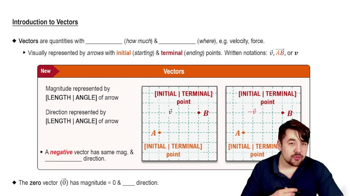
Introduction to Vectors

Magnitude and Direction Angle of a Vector

The magnitude of a vector is its length, denoted ||v||, and the direction angle θ is the angle it makes with the positive x-axis, measured counterclockwise. These two parameters uniquely define the vector's position in the plane.
추천 영상:
04:55
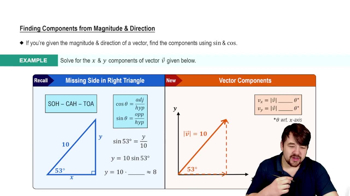
Finding Components from Direction and Magnitude

Converting Polar Form to Cartesian Components

To express a vector given by magnitude and direction angle in terms of i and j, use trigonometric functions: the x-component is ||v|| cos θ and the y-component is ||v|| sin θ. This conversion translates polar coordinates into Cartesian vector components.
추천 영상:
03:55
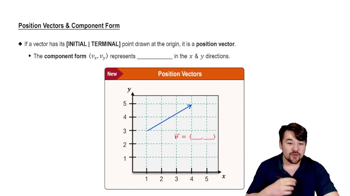
Position Vectors & Component Form