Ch. 4 - Laws of Sines and Cosines; Vectors
Blitzer - Trigonometry 3rd Edition
Blitzer3rd EditionTrigonometryISBN: 9780137316601당신이 사용하는 게 아니라요?교과서 변경
4장, 문제 1

In oblique triangle ABC, A = 34°, B = 68°, and a = 4.8. Find b to the nearest tenth.

검증된 단계별 안내
1
Identify the given information: angle A = 34°, angle B = 68°, and side a = 4.8 opposite angle A.
Calculate the third angle C using the triangle angle sum property: \(C = 180^\circ - A - B\).
Use the Law of Sines to relate sides and angles: \(\frac{a}{\sin A} = \frac{b}{\sin B}\).
Rearrange the Law of Sines formula to solve for side b: \(b = \frac{a \cdot \sin B}{\sin A}\).
Substitute the known values of a, A, and B into the formula and prepare to calculate b (do not compute the final value).

비슷한 문제에 대한 검증된 영상 답변:

이 영상 해법은 위 문제에 도움이 된다고 튜터들이 추천한 것입니다.
영상 길이:
2m
도움이 되었나요?

주요 개념

질문에 올바르게 답하기 위해 반드시 이해해야 하는 핵심 개념들은 다음과 같습니다.

Angle Sum Property of a Triangle

The sum of the interior angles in any triangle is always 180°. Knowing two angles allows you to find the third by subtracting their sum from 180°, which is essential for solving oblique triangles.
추천 영상:
4:47
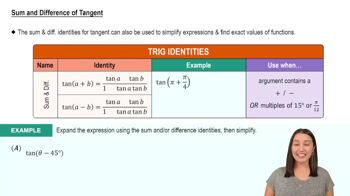
Sum and Difference of Tangent

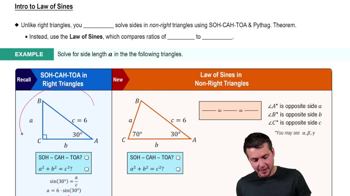
Law of Sines

The Law of Sines relates the sides and angles of a triangle: (a/sin A) = (b/sin B) = (c/sin C). It is used to find unknown sides or angles in oblique triangles when given some combination of sides and angles.
추천 영상:
가이드 코스
4:27
Intro to Law of Sines

Rounding and Approximation

When solving trigonometric problems, especially with decimals, rounding to a specified precision (here, the nearest tenth) is important for clarity and practical use. This involves using appropriate significant figures after calculation.
추천 영상:
4:45
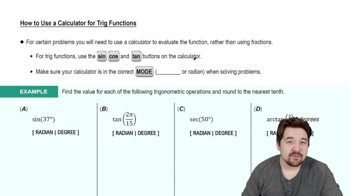
How to Use a Calculator for Trig Functions