Ch. 4 - Laws of Sines and Cosines; Vectors
Blitzer - Trigonometry 3rd Edition
Blitzer3rd EditionTrigonometryISBN: 9780137316601당신이 사용하는 게 아니라요?교과서 변경
4장, 문제 4.18

Let v be the vector from initial point P₁ to terminal point P₂. Write v in terms of i and j.


P₁ = (-1, 6), P₂ = (7, -5)

검증된 단계별 안내
1
Identify the coordinates of the initial point P₁ and the terminal point P₂. Here, P₁ = (-1, 6) and P₂ = (7, -5).
To find the vector \( \mathbf{v} \) from P₁ to P₂, calculate the difference between the corresponding coordinates of P₂ and P₁.
Subtract the x-coordinate of P₁ from the x-coordinate of P₂ to find the i-component: \( 7 - (-1) \).
Subtract the y-coordinate of P₁ from the y-coordinate of P₂ to find the j-component: \( -5 - 6 \).
Express the vector \( \mathbf{v} \) in terms of \( \mathbf{i} \) and \( \mathbf{j} \) using the components calculated: \( \mathbf{v} = (7 - (-1))\mathbf{i} + (-5 - 6)\mathbf{j} \).

비슷한 문제에 대한 검증된 영상 답변:

이 영상 해법은 위 문제에 도움이 된다고 튜터들이 추천한 것입니다.
영상 길이:
2m
도움이 되었나요?

주요 개념

질문에 올바르게 답하기 위해 반드시 이해해야 하는 핵심 개념들은 다음과 같습니다.

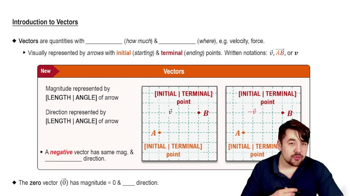
Vectors

A vector is a mathematical object that has both magnitude and direction. In a two-dimensional space, a vector can be represented as an ordered pair of coordinates, indicating its position relative to a reference point. The vector from point P₁ to point P₂ can be calculated by subtracting the coordinates of P₁ from those of P₂.
추천 영상:
03:48
Introduction to Vectors

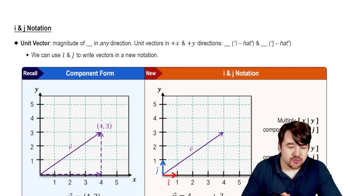
Unit Vectors i and j

In the Cartesian coordinate system, the unit vectors i and j represent the directions along the x-axis and y-axis, respectively. The vector i is typically represented as (1, 0), while j is represented as (0, 1). When expressing a vector in terms of i and j, we decompose it into its horizontal and vertical components, allowing for a clearer understanding of its direction and magnitude.
추천 영상:
06:01
i & j Notation

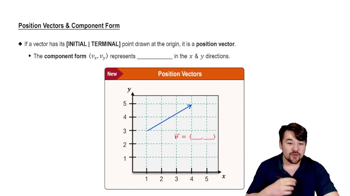
Vector Components

Vector components are the projections of a vector along the axes of a coordinate system. For a vector v from P₁ to P₂, the components can be found by calculating the difference in the x-coordinates and the y-coordinates of the points. This results in a vector expressed as v = (x-component)i + (y-component)j, which simplifies the analysis of the vector's direction and length.
추천 영상:
03:55
Position Vectors & Component Form