Ch. 5 - Complex Numbers, Polar Coordinates and Parametric Equations
Blitzer - Trigonometry 3rd Edition
Blitzer3rd EditionTrigonometryISBN: 9780137316601당신이 사용하는 게 아니라요?교과서 변경
5장, 문제 1

In Exercises 1–10, indicate if the point with the given polar coordinates is represented by A, B, C, or D on the graph. (3, 225°)

검증된 단계별 안내
1
Recall that polar coordinates are given in the form \((r, \theta)\), where \(r\) is the distance from the origin and \(\theta\) is the angle measured counterclockwise from the positive x-axis.
Identify the given coordinates: \(r = 3\) and \(\theta = 225^\circ\).
Convert the angle \(225^\circ\) to radians if needed, or understand its position on the unit circle. Since \(225^\circ\) is in the third quadrant (between \(180^\circ\) and \(270^\circ\)), the point lies diagonally down-left from the origin.
Plot the point by moving 3 units from the origin in the direction of \(225^\circ\). This means moving 3 units into the third quadrant along the line that makes a \(225^\circ\) angle with the positive x-axis.
Compare the plotted point with points A, B, C, and D on the graph to determine which one matches the location of \((3, 225^\circ)\).

비슷한 문제에 대한 검증된 영상 답변:

이 영상 해법은 위 문제에 도움이 된다고 튜터들이 추천한 것입니다.
영상 길이:
2m
도움이 되었나요?

주요 개념

질문에 올바르게 답하기 위해 반드시 이해해야 하는 핵심 개념들은 다음과 같습니다.

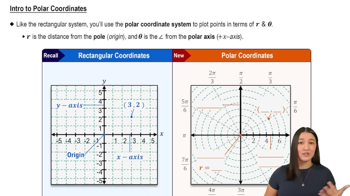
Polar Coordinates System

Polar coordinates represent points in a plane using a distance from the origin (radius) and an angle measured from the positive x-axis. Each point is given as (r, θ), where r is the radius and θ is the angle in degrees or radians.
추천 영상:
05:32
Intro to Polar Coordinates

Angle Measurement and Quadrants

Angles in polar coordinates are measured counterclockwise from the positive x-axis. Understanding which quadrant an angle lies in helps locate the point; for example, 225° lies in the third quadrant, where both x and y coordinates are negative.
추천 영상:
6:36
Quadratic Formula

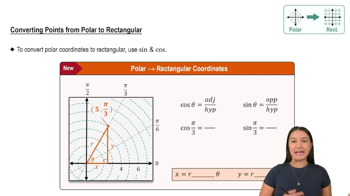
Plotting Points from Polar to Cartesian Coordinates

To plot a polar point on a Cartesian graph, convert (r, θ) to (x, y) using x = r cos θ and y = r sin θ. This conversion helps identify the exact location of the point on the graph and match it to labeled points A, B, C, or D.
추천 영상:
06:17
Convert Points from Polar to Rectangular