In Exercises 11–26, plot each complex number. Then write the complex number in polar form. You may express the argument in degrees or radians. −4i
Ch. 5 - Complex Numbers, Polar Coordinates and Parametric Equations

5장, 문제 15
Write each complex number in rectangular form. If necessary, round to the nearest tenth. 8(cos 60° + i sin 60°)
검증된 단계별 안내1
Recognize that the given complex number is in polar (trigonometric) form: \(r(\cos \theta + i \sin \theta)\), where \(r = 8\) and \(\theta = 60^\circ\).
Recall that to convert from polar form to rectangular form, use the formulas: \(x = r \cos \theta\) and \(y = r \sin \theta\), where \(x\) is the real part and \(y\) is the imaginary part.
Calculate the real part: \(x = 8 \times \cos 60^\circ\).
Calculate the imaginary part: \(y = 8 \times \sin 60^\circ\).
Write the rectangular form as \(x + yi\), substituting the values found for \(x\) and \(y\). If necessary, round the values to the nearest tenth.

비슷한 문제에 대한 검증된 영상 답변:
이 영상 해법은 위 문제에 도움이 된다고 튜터들이 추천한 것입니다.
영상 길이:
2m도움이 되었나요?
주요 개념
질문에 올바르게 답하기 위해 반드시 이해해야 하는 핵심 개념들은 다음과 같습니다.
Polar and Rectangular Forms of Complex Numbers
Complex numbers can be expressed in polar form as r(cos θ + i sin θ), where r is the magnitude and θ is the argument. The rectangular form represents the same number as a + bi, where a and b are real numbers corresponding to the horizontal and vertical components on the complex plane.
추천 영상:
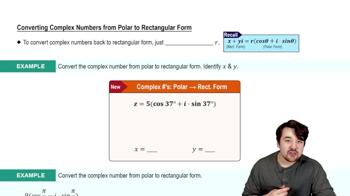
Converting Complex Numbers from Polar to Rectangular Form
Conversion from Polar to Rectangular Form
To convert a complex number from polar to rectangular form, multiply the magnitude r by cos θ to find the real part (a), and multiply r by sin θ to find the imaginary part (b). This yields a + bi, which is easier to interpret and use in algebraic operations.
추천 영상:
Converting Complex Numbers from Polar to Rectangular Form
Trigonometric Values and Rounding
Evaluating cos 60° and sin 60° requires knowledge of standard trigonometric values. After calculating the real and imaginary parts, round the results to the nearest tenth if necessary, ensuring the final rectangular form is precise and suitable for practical use.
추천 영상:
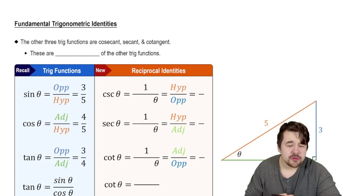
Fundamental Trigonometric Identities
관련 실천
교과서 질문
467
views
교과서 질문
Test for symmetry and then graph each polar equation. r = 2 cos θ
786
views
교과서 질문
Eliminate the parameter and graph the plane curve represented by the parametric equations. Use arrows to show the orientation of each plane curve. x = √t , y = t + 1; −∞ < t < ∞
804
views
교과서 질문
Use a polar coordinate system like the one shown for Exercises 1–10 to plot each point with the given polar coordinates. (3, 90°)
806
views
교과서 질문
In Exercises 11–20, use a polar coordinate system like the one shown for Exercises 1–10 to plot each point with the given polar coordinates. (3, 4π/3)
853
views
교과서 질문
In Exercises 13–34, test for symmetry and then graph each polar equation. r = 1 − sin θ
802
views