Ch. 5 - Complex Numbers, Polar Coordinates and Parametric Equations
Blitzer - Trigonometry 3rd Edition
Blitzer3rd EditionTrigonometryISBN: 9780137316601당신이 사용하는 게 아니라요?교과서 변경
5장, 문제 25

In Exercises 21–26, use a polar coordinate system like the one shown for Exercises 1–10 to plot each point with the given polar coordinates. Then find another representation of this point in which a. r>0, 2π < θ < 4π. b. r<0, 0. < θ < 2π. c. r>0, −2π. < θ < 0. (4, π/2)

검증된 단계별 안내
1
Step 1: Understand the given polar coordinates. The point is given as \((r, \theta) = (4, \frac{\pi}{2})\), where \(r\) is the radius (distance from the origin) and \(\theta\) is the angle measured in radians from the positive x-axis.
Step 2: For part (a), find another representation with \(r > 0\) and \(2\pi < \theta < 4\pi\). Since the angle \(\theta\) can be coterminal by adding multiples of \(2\pi\), add \(2\pi\) to the original angle \(\frac{\pi}{2}\) to get a new angle in the desired range: \(\theta = \frac{\pi}{2} + 2\pi\).
Step 3: For part (b), find another representation with \(r < 0\) and \(0 < \theta < 2\pi\). When \(r\) is negative, the point is in the opposite direction of the angle \(\theta\). To find such a representation, add \(\pi\) to the original angle and change the sign of \(r\): \(r = -4\), \(\theta = \frac{\pi}{2} + \pi\).
Step 4: For part (c), find another representation with \(r > 0\) and \(-2\pi < \theta < 0\). To get an angle in this range, subtract \(2\pi\) from the original angle: \(\theta = \frac{\pi}{2} - 2\pi\) while keeping \(r = 4\).
Step 5: Summarize the new representations found for each part, ensuring the radius and angle satisfy the given conditions, and note that all these points represent the same location in the polar coordinate system.

비슷한 문제에 대한 검증된 영상 답변:

이 영상 해법은 위 문제에 도움이 된다고 튜터들이 추천한 것입니다.
영상 길이:
2m
도움이 되었나요?

주요 개념

질문에 올바르게 답하기 위해 반드시 이해해야 하는 핵심 개념들은 다음과 같습니다.

Polar Coordinates and Their Representation

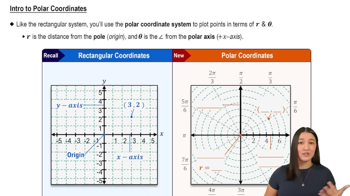
Polar coordinates represent points in a plane using a radius (r) and an angle (θ). The radius indicates the distance from the origin, while the angle measures the counterclockwise rotation from the positive x-axis. Understanding how to plot points and interpret these coordinates is fundamental for working with polar systems.
추천 영상:
05:32
Intro to Polar Coordinates

Multiple Representations of Polar Coordinates

A single point in polar coordinates can have multiple representations by adjusting r and θ. Adding or subtracting multiples of 2π to θ or changing the sign of r while shifting θ by π yields equivalent points. This flexibility allows expressing the same point in different angular intervals or with positive/negative radii.
추천 영상:
05:32
Intro to Polar Coordinates

Angle Interval Adjustments in Polar Coordinates

Angles in polar coordinates can be expressed within various intervals, such as (0, 2π), (2π, 4π), or negative ranges like (−2π, 0). Converting angles to fit these intervals involves adding or subtracting 2π as needed. Mastery of these adjustments is essential for finding alternate representations of points within specified angle bounds.
추천 영상:
05:32
Intro to Polar Coordinates