Ch. 5 - Complex Numbers, Polar Coordinates and Parametric Equations
Blitzer - Trigonometry 3rd Edition
Blitzer3rd EditionTrigonometryISBN: 9780137316601당신이 사용하는 게 아니라요?교과서 변경
5장, 문제 31

In Exercises 30–31, find all the complex roots. Write roots in polar form with θ in degrees. The complex cube roots of 125(cos 165° + i sin 165°)

검증된 단계별 안내
1
Identify the given complex number in polar form: \(125(\cos 165^\circ + i \sin 165^\circ)\), where the modulus \(r = 125\) and the argument \(\theta = 165^\circ\).
Recall that to find the cube roots of a complex number in polar form \(r(\cos \theta + i \sin \theta)\), the roots are given by: \(\sqrt[3]{r} \left( \cos \left( \frac{\theta + 360^\circ k}{3} \right) + i \sin \left( \frac{\theta + 360^\circ k}{3} \right) \right)\), where \(k = 0, 1, 2\).
Calculate the cube root of the modulus: \(\sqrt[3]{125}\), which will be the modulus of each root.
For each integer \(k = 0, 1, 2\), compute the argument of each root by evaluating \(\frac{165^\circ + 360^\circ k}{3}\).
Write each root in polar form as \(r_k (\cos \theta_k + i \sin \theta_k)\) using the modulus from step 3 and the arguments from step 4.

비슷한 문제에 대한 검증된 영상 답변:

이 영상 해법은 위 문제에 도움이 된다고 튜터들이 추천한 것입니다.
영상 길이:
7m
도움이 되었나요?

주요 개념

질문에 올바르게 답하기 위해 반드시 이해해야 하는 핵심 개념들은 다음과 같습니다.

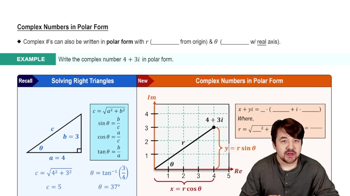
Complex Numbers in Polar Form

Complex numbers can be expressed in polar form as r(cos θ + i sin θ), where r is the magnitude and θ is the argument (angle). This form simplifies multiplication, division, and finding roots by working with magnitudes and angles separately.
추천 영상:
04:47
Complex Numbers In Polar Form

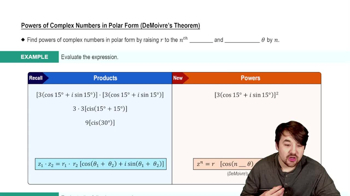
De Moivre's Theorem

De Moivre's theorem states that for a complex number in polar form, raising it to the power n results in r^n (cos nθ + i sin nθ). Conversely, the nth roots can be found by taking the nth root of the magnitude and dividing the angle by n, adding multiples of 360°/n for all roots.
추천 영상:
03:41
Powers Of Complex Numbers In Polar Form (DeMoivre's Theorem)

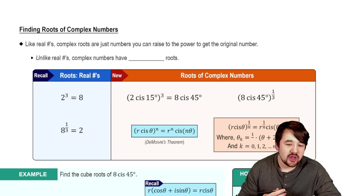
Finding Complex Roots

To find the nth roots of a complex number, calculate the nth root of the magnitude and determine the arguments by dividing the original angle by n and adding k(360°/n) for k = 0, 1, ..., n-1. This yields all distinct roots evenly spaced around the circle.
추천 영상:
07:37
Complex Roots