Ch. 5 - Complex Numbers, Polar Coordinates and Parametric Equations
Blitzer - Trigonometry 3rd Edition
Blitzer3rd EditionTrigonometryISBN: 9780137316601당신이 사용하는 게 아니라요?교과서 변경
5장, 문제 41

In Exercises 37–44, find the product of the complex numbers. Leave answers in polar form. z₁ = cos π/4 + i sin π/4 z₂ = cos π/3 + i sin π/3

검증된 단계별 안내
1
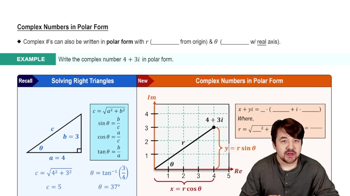
Recall that complex numbers in the form \(z = \cos \theta + i \sin \theta\) are expressed in polar form, where \(\theta\) is the argument (angle) of the complex number.
To find the product of two complex numbers in polar form, use the formula: if \(z_1 = \cos \alpha + i \sin \alpha\) and \(z_2 = \cos \beta + i \sin \beta\), then their product is \(z_1 z_2 = \cos(\alpha + \beta) + i \sin(\alpha + \beta)\).
Identify the angles for the given complex numbers: \(\alpha = \frac{\pi}{4}\) for \(z_1\) and \(\beta = \frac{\pi}{3}\) for \(z_2\).
Add the angles: calculate \(\alpha + \beta = \frac{\pi}{4} + \frac{\pi}{3}\), which will be the argument of the product.
Write the product in polar form as \(z_1 z_2 = \cos\left(\frac{\pi}{4} + \frac{\pi}{3}\right) + i \sin\left(\frac{\pi}{4} + \frac{\pi}{3}\right)\).

비슷한 문제에 대한 검증된 영상 답변:

이 영상 해법은 위 문제에 도움이 된다고 튜터들이 추천한 것입니다.
영상 길이:
4m
도움이 되었나요?

주요 개념

질문에 올바르게 답하기 위해 반드시 이해해야 하는 핵심 개념들은 다음과 같습니다.

Complex Numbers in Polar Form

Complex numbers can be expressed in polar form as r(cos θ + i sin θ), where r is the magnitude and θ is the argument (angle). This form highlights the geometric interpretation of complex numbers as points or vectors in the plane, making multiplication and division more intuitive.
추천 영상:
04:47
Complex Numbers In Polar Form

Multiplication of Complex Numbers in Polar Form

When multiplying two complex numbers in polar form, multiply their magnitudes and add their angles. Specifically, if z₁ = r₁(cos θ₁ + i sin θ₁) and z₂ = r₂(cos θ₂ + i sin θ₂), then z₁z₂ = r₁r₂ [cos(θ₁ + θ₂) + i sin(θ₁ + θ₂)]. This simplifies the product calculation significantly.
추천 영상:
04:47
Complex Numbers In Polar Form

Euler's Formula and Trigonometric Representation

Euler's formula states that e^(iθ) = cos θ + i sin θ, linking exponential and trigonometric forms of complex numbers. This connection helps understand the polar form and the behavior of complex multiplication as rotation and scaling in the complex plane.
추천 영상:
6:36
Quadratic Formula