In Exercises 59–74, convert each polar equation to a rectangular equation. Then use a rectangular coordinate system to graph the rectangular equation. r = 8
Ch. 5 - Complex Numbers, Polar Coordinates and Parametric Equations

모든 교과서
Blitzer 3rd Edition
Ch. 5 - Complex Numbers, Polar Coordinates and Parametric Equations
문제 5.5.55
Blitzer 3rd Edition
Ch. 5 - Complex Numbers, Polar Coordinates and Parametric Equations
문제 5.5.555장, 문제 5.5.55
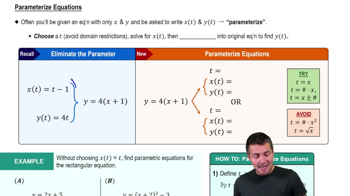
In Exercises 53–56, find two different sets of parametric equations for each rectangular equation. y = x² + 4
검증된 단계별 안내1
Recognize that the given rectangular equation is a parabola: \(y = x^{2} + 4\). Our goal is to express both \(x\) and \(y\) in terms of a parameter \(t\) to form parametric equations.
For the first set of parametric equations, let the parameter \(t\) represent \(x\). So, set \(x = t\). Then, substitute \(t\) into the original equation to find \(y\): \(y = t^{2} + 4\). Thus, the first set is \(x = t\), \(y = t^{2} + 4\).
For the second set, choose a different parameterization. For example, let \(t\) represent \(y\). From the original equation, solve for \(x\) in terms of \(y\): \(x = \pm \sqrt{y - 4}\). To avoid ambiguity, pick one branch, say the positive root, and set \(y = t\). Then, \(x = \sqrt{t - 4}\). So the second set is \(x = \sqrt{t - 4}\), \(y = t\), with the domain \(t \geq 4\).
Alternatively, for the second set, you can introduce a trigonometric parameterization by letting \(x = 2 \tan t\). Substitute into the original equation: \(y = (2 \tan t)^{2} + 4 = 4 \tan^{2} t + 4\). So the parametric equations become \(x = 2 \tan t\), \(y = 4 \tan^{2} t + 4\), where \(t\) is in the domain where \(\tan t\) is defined.
Summarize that parametric equations are flexible and can be chosen by assigning the parameter to either \(x\), \(y\), or a function of \(t\), then expressing the other variable accordingly to satisfy the original rectangular equation.

비슷한 문제에 대한 검증된 영상 답변:
이 영상 해법은 위 문제에 도움이 된다고 튜터들이 추천한 것입니다.
영상 길이:
1m도움이 되었나요?
주요 개념
질문에 올바르게 답하기 위해 반드시 이해해야 하는 핵심 개념들은 다음과 같습니다.
Rectangular and Parametric Equations
A rectangular equation relates x and y directly, while parametric equations express both x and y as functions of a third variable, usually t. Converting between these forms allows for different representations of the same curve, useful in analyzing motion or graphing.
추천 영상:
Parameterizing Equations
Parametrization Techniques
Parametrization involves choosing a parameter t and expressing x and y in terms of t to satisfy the original equation. Common methods include letting x = t and solving for y, or using trigonometric or polynomial functions to create alternative parameter sets.
추천 영상:
Parameterizing Equations
Quadratic Functions and Their Graphs
The given equation y = x² + 4 is a parabola shifted upward by 4 units. Understanding the shape and properties of quadratic functions helps in selecting appropriate parametric forms that trace the curve accurately.
추천 영상:
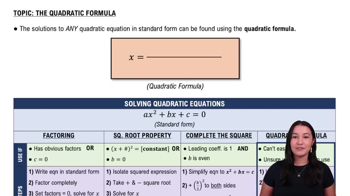
Quadratic Formula
관련 실천
교과서 질문
866
views
교과서 질문
In Exercises 53–64, use DeMoivre's Theorem to find the indicated power of the complex number. Write answers in rectangular form. (1 + i)⁵
571
views
교과서 질문
In Exercises 29–36, simplify and write the result in standard form.
√3² − 4 ⋅ 2 ⋅ 5
469
views
교과서 질문
In Exercises 21–28, divide and express the result in standard form.
2+3i / 2+i
572
views
교과서 질문
In Exercises 45–52, use your answers from Exercises 41–44 and the parametric equations given in Exercises 41–44 to find a set of parametric equations for the conic section or the line.
Ellipse: Center: (−2,3); Vertices: 5 units to the left and right of the center; Endpoints of Minor Axis: 2 units above and below the center
480
views
교과서 질문
In Exercises 1–10, perform the indicated operations and write the result in standard form. (3 − 4i)²
769
views