Ch. 5 - Complex Numbers, Polar Coordinates and Parametric Equations
Blitzer - Trigonometry 3rd Edition
Blitzer3rd EditionTrigonometryISBN: 9780137316601당신이 사용하는 게 아니라요?교과서 변경
5장, 문제 5.2.62

In Exercises 53–64, use DeMoivre's Theorem to find the indicated power of the complex number. Write answers in rectangular form. (1 − i)⁵

검증된 단계별 안내
1
Express the complex number \(1 - i\) in polar form. First, find the modulus \(r\) using \(r = \sqrt{a^2 + b^2}\), where \(a = 1\) and \(b = -1\).
Calculate the argument \(\theta\) of the complex number using \(\theta = \tan^{-1}\left(\frac{b}{a}\right)\). Remember to consider the correct quadrant for \(\theta\).
Write the complex number in polar form as \(r(\cos \theta + i \sin \theta)\).
Apply DeMoivre's Theorem to raise the complex number to the 5th power: \(\left[r(\cos \theta + i \sin \theta)\right]^5 = r^5 \left(\cos(5\theta) + i \sin(5\theta)\right)\).
Convert the result back to rectangular form by calculating \(r^5 \cos(5\theta)\) for the real part and \(r^5 \sin(5\theta)\) for the imaginary part.

비슷한 문제에 대한 검증된 영상 답변:

이 영상 해법은 위 문제에 도움이 된다고 튜터들이 추천한 것입니다.
영상 길이:
10m
도움이 되었나요?

주요 개념

질문에 올바르게 답하기 위해 반드시 이해해야 하는 핵심 개념들은 다음과 같습니다.

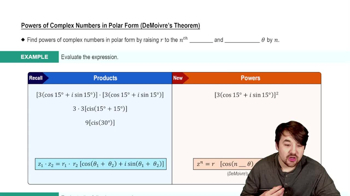
DeMoivre's Theorem

DeMoivre's Theorem states that for a complex number expressed in polar form as r(cos θ + i sin θ), its nth power is r^n (cos nθ + i sin nθ). This theorem simplifies raising complex numbers to powers by working with their magnitude and angle instead of expanding binomials.
추천 영상:
03:41
Powers Of Complex Numbers In Polar Form (DeMoivre's Theorem)

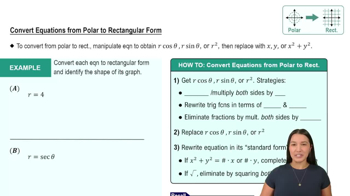
Conversion between Rectangular and Polar Forms

Complex numbers can be represented in rectangular form (a + bi) or polar form (r(cos θ + i sin θ)). Converting to polar form involves finding the magnitude r = √(a² + b²) and the argument θ = arctan(b/a), which is essential for applying DeMoivre's Theorem.
추천 영상:
6:50
Convert Equations from Polar to Rectangular

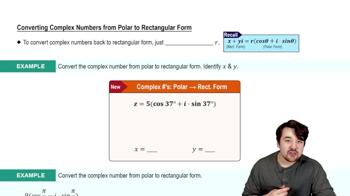
Rectangular Form of Complex Numbers

Rectangular form expresses complex numbers as a + bi, where a is the real part and b is the imaginary part. After using DeMoivre's Theorem in polar form, the result must be converted back to rectangular form by evaluating r^n cos nθ and r^n sin nθ to find the real and imaginary components.
추천 영상:
03:58
Converting Complex Numbers from Polar to Rectangular Form