In Exercises 1–10, perform the indicated operations and write the result in standard form. (7 + 8i)(7 − 8i)
Ch. 5 - Complex Numbers, Polar Coordinates and Parametric Equations

모든 교과서
Blitzer 3rd Edition
Ch. 5 - Complex Numbers, Polar Coordinates and Parametric Equations
문제 5.2.57
Blitzer 3rd Edition
Ch. 5 - Complex Numbers, Polar Coordinates and Parametric Equations
문제 5.2.575장, 문제 5.2.57
In Exercises 53–64, use DeMoivre's Theorem to find the indicated power of the complex number. Write answers in rectangular form. [1/2 (cos π/12 + i sin π/12)]⁶
검증된 단계별 안내1
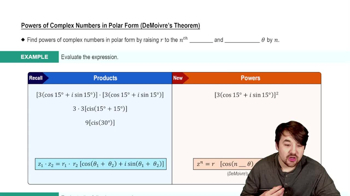
Recall DeMoivre's Theorem, which states that for a complex number in polar form \(r(\cos \theta + i \sin \theta)\), its \(n\)th power is given by \(r^n (\cos(n\theta) + i \sin(n\theta))\).
Identify the given complex number's modulus and argument: here, \(r = \frac{1}{2}\) and \(\theta = \frac{\pi}{12}\).
Apply DeMoivre's Theorem to raise the complex number to the 6th power: compute \(r^6 = \left(\frac{1}{2}\right)^6\) and multiply the angle by 6 to get \(6 \times \frac{\pi}{12} = \frac{6\pi}{12} = \frac{\pi}{2}\).
Write the result in polar form: \(\left(\frac{1}{2}\right)^6 \left( \cos \frac{\pi}{2} + i \sin \frac{\pi}{2} \right)\).
Convert the polar form back to rectangular form by evaluating \(\cos \frac{\pi}{2}\) and \(\sin \frac{\pi}{2}\), then multiply by \(\left(\frac{1}{2}\right)^6\) to get the final rectangular form.

비슷한 문제에 대한 검증된 영상 답변:
이 영상 해법은 위 문제에 도움이 된다고 튜터들이 추천한 것입니다.
영상 길이:
5m도움이 되었나요?
주요 개념
질문에 올바르게 답하기 위해 반드시 이해해야 하는 핵심 개념들은 다음과 같습니다.
DeMoivre's Theorem
DeMoivre's Theorem states that for a complex number in polar form, (r(cos θ + i sin θ))^n = r^n (cos nθ + i sin nθ). It allows raising complex numbers to integer powers by multiplying the angle and raising the magnitude to the power.
추천 영상:
Powers Of Complex Numbers In Polar Form (DeMoivre's Theorem)
Polar and Rectangular Forms of Complex Numbers
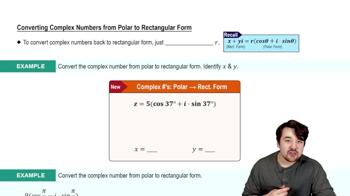
Complex numbers can be expressed in rectangular form (a + bi) or polar form (r(cos θ + i sin θ)). Converting between these forms is essential for applying DeMoivre's Theorem and then rewriting the result back into rectangular form.
추천 영상:
Converting Complex Numbers from Polar to Rectangular Form
Trigonometric Identities for Cosine and Sine
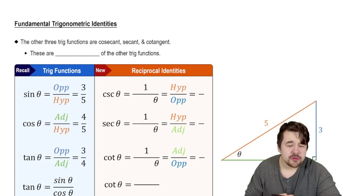
Using trigonometric identities helps simplify expressions like cos(nθ) and sin(nθ) after applying DeMoivre's Theorem. Understanding these identities aids in accurately converting the final result into rectangular form.
추천 영상:
Fundamental Trigonometric Identities
관련 실천
교과서 질문
676
views
교과서 질문
In Exercises 59–74, convert each polar equation to a rectangular equation. Then use a rectangular coordinate system to graph the rectangular equation. r = 4 csc θ
912
views
교과서 질문
In Exercises 1–8, add or subtract as indicated and write the result in standard form. 6 − (−5 + 4i) − (−13 − i)
921
views
교과서 질문
In Exercises 59–74, convert each polar equation to a rectangular equation. Then use a rectangular coordinate system to graph the rectangular equation. r = 8
866
views
교과서 질문
In Exercises 49–58, convert each rectangular equation to a polar equation that expresses r in terms of θ. 3x + y = 7
726
views
교과서 질문
In Exercises 53–58, perform the indicated operation(s) and write the result in standard form. ___ ___ 5√(−16) + 3√(−81)
715
views