In Exercises 65–68, find all the complex roots. Write roots in polar form with θ in degrees. The complex cube roots of 27(cos 306° + i sin 306°)
Ch. 5 - Complex Numbers, Polar Coordinates and Parametric Equations

5장, 문제 69
In Exercises 69–76, find all the complex roots. Write roots in rectangular form. If necessary, round to the nearest tenth. The complex fourth roots of 81 (cos 4π/3 + i sin 4π/3)
검증된 단계별 안내1
Recognize that the problem asks for the fourth roots of a complex number given in polar form: \(81 \left( \cos \frac{4\pi}{3} + i \sin \frac{4\pi}{3} \right)\). The general form for the \(n\)th roots of a complex number \(r (\cos \theta + i \sin \theta)\) is given by De Moivre's Theorem.
Identify the magnitude \(r = 81\) and the argument \(\theta = \frac{4\pi}{3}\). Since we want the fourth roots, set \(n = 4\). The magnitude of each root will be \(r^{1/n} = 81^{1/4}\).
Calculate the arguments of the roots using the formula: \(\theta_k = \frac{\theta + 2\pi k}{n}\) for \(k = 0, 1, 2, 3\). This gives four distinct angles for the roots.
Write each root in polar form as \(r^{1/n} \left( \cos \theta_k + i \sin \theta_k \right)\) for each \(k\).
Convert each root from polar form to rectangular form using \(x = r^{1/n} \cos \theta_k\) and \(y = r^{1/n} \sin \theta_k\), then express each root as \(x + iy\). Round the values to the nearest tenth if necessary.

비슷한 문제에 대한 검증된 영상 답변:
이 영상 해법은 위 문제에 도움이 된다고 튜터들이 추천한 것입니다.
영상 길이:
10m도움이 되었나요?
주요 개념
질문에 올바르게 답하기 위해 반드시 이해해야 하는 핵심 개념들은 다음과 같습니다.
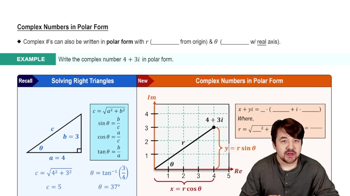
Complex Numbers in Polar Form
Complex numbers can be expressed in polar form as r(cos θ + i sin θ), where r is the magnitude and θ is the argument (angle). This form is useful for multiplying, dividing, and finding roots of complex numbers by working with their magnitudes and angles separately.
추천 영상:
Complex Numbers In Polar Form
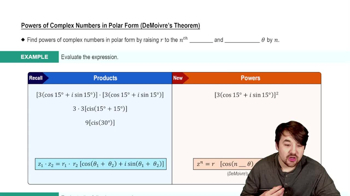
De Moivre's Theorem
De Moivre's theorem states that for a complex number in polar form, raising it to the nth power corresponds to raising the magnitude to the nth power and multiplying the angle by n. Conversely, finding nth roots involves taking the nth root of the magnitude and dividing the angle by n, adding multiples of 2π/n for all roots.
추천 영상:
Powers Of Complex Numbers In Polar Form (DeMoivre's Theorem)
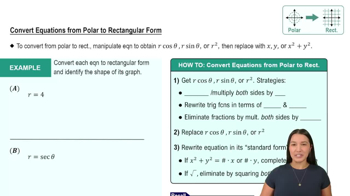
Conversion Between Polar and Rectangular Forms
After finding roots in polar form, converting them to rectangular form (a + bi) requires using a = r cos θ and b = r sin θ. This step is essential for expressing complex roots in the standard form, which is often required for clarity and further calculations.
추천 영상:
Convert Equations from Polar to Rectangular
관련 실천
교과서 질문
512
views
교과서 질문
In Exercises 65–68, find all the complex roots. Write roots in polar form with θ in degrees. The complex cube roots of 8(cos 210° + i sin 210°)
610
views
교과서 질문
In Exercises 69–76, find all the complex roots. Write roots in rectangular form. If necessary, round to the nearest tenth. The complex fifth roots of 32
528
views
교과서 질문
In Exercises 59–74, convert each polar equation to a rectangular equation. Then use a rectangular coordinate system to graph the rectangular equation. r = 12 cos θ
973
views
교과서 질문
In Exercises 69–76, find all the complex roots. Write roots in rectangular form. If necessary, round to the nearest tenth. The complex fifth roots of 32 (cos 5π/3 + i sin 5π/3)
527
views
교과서 질문
In Exercises 64–70, graph each polar equation. Be sure to test for symmetry.r = 2 + cos θ
774
views