

Sketch an angle θ in standard position such that θ has the least positive measure, and the given point is on the terminal side of θ. Then find the values of the six trigonometric functions for each angle. Rationalize denominators when applicable. See Examples 1, 2, and 4. (0, ―3)
Ch. 1 - Trigonometric Functions
2장, 문제 24
Find the measure of each marked angle. See Example 2.
검증된 단계별 안내1
Identify the given angles and the relationships between them in the diagram. Common relationships include complementary angles (sum to 90°), supplementary angles (sum to 180°), vertical angles (equal), and angles formed by parallel lines and a transversal (alternate interior, corresponding, etc.).
Write down the known angle measures and set variables for the unknown marked angles you need to find.
Use the appropriate angle relationships to set up equations. For example, if two angles are supplementary, write the equation as \(x + y = 180\); if they are complementary, write \(x + y = 90\); if they are vertical angles, set them equal: \(x = y\).
Solve the system of equations you have created to find the values of the unknown angles. This may involve substitution or elimination methods depending on the number of variables.
Check your answers by verifying that all angle relationships in the diagram are satisfied, ensuring the sum of angles around a point or on a straight line matches the expected total.

비슷한 문제에 대한 검증된 영상 답변:
이 영상 해법은 위 문제에 도움이 된다고 튜터들이 추천한 것입니다.
영상 길이:
3m도움이 되었나요?
주요 개념
질문에 올바르게 답하기 위해 반드시 이해해야 하는 핵심 개념들은 다음과 같습니다.
Angle Measurement Units
Understanding how angles are measured, typically in degrees or radians, is fundamental. Degrees divide a circle into 360 parts, while radians relate the angle to the radius of a circle. Knowing how to convert between these units is essential for solving angle problems.
추천 영상:
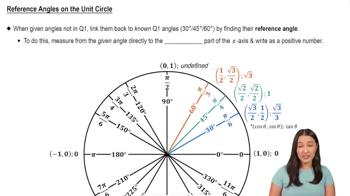
Reference Angles on the Unit Circle
Properties of Angles
Familiarity with angle properties such as complementary, supplementary, vertical, and adjacent angles helps in determining unknown angle measures. For example, supplementary angles sum to 180°, and vertical angles are equal, which are often used to find missing angles.
추천 영상:
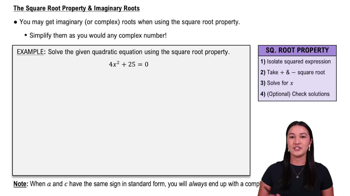
Imaginary Roots with the Square Root Property
Trigonometric Ratios and Functions
Trigonometric functions like sine, cosine, and tangent relate angles to side lengths in right triangles. These ratios are crucial for calculating unknown angles when side lengths are known, or vice versa, and are often applied in problems involving marked angles.
추천 영상:
Introduction to Trigonometric Functions
관련 실천
교과서 질문
627
views
교과서 질문
Use the appropriate reciprocal identity to find each function value. Rationalize denominators when applicable. See Example 1.
sin θ , given that csc θ = 1.25
1024
views
교과서 질문
Find the measure of each marked angle. See Example 2.
505
views
교과서 질문
Length of a Shadow If a tree 20 ft tall casts a shadow 8 ft long, how long would the shadow of a 30-ft tree be at the same time and place?
839
views
교과서 질문
Find the measure of each marked angle. See Example 2.
554
views
교과서 질문
Find the six trigonometric function values for each angle. Rationalize denominators when applicable.
798
views
