Find the measure of each marked angle. See Example 2 complementary angles with measures 3𝓍 ― 5 and 6𝓍 ― 40 degrees
Ch. 1 - Trigonometric Functions
2장, 문제 31
Find the values of the six trigonometric functions for an angle in standard position having each given point on its terminal side. Rationalize denominators when applicable. (6√3 , ―6)
검증된 단계별 안내1
Identify the coordinates of the point on the terminal side of the angle: \(x = 6\sqrt{3}\) and \(y = -6\).
Calculate the radius (or hypotenuse) \(r\) using the distance formula: \(r = \sqrt{x^2 + y^2} = \sqrt{(6\sqrt{3})^2 + (-6)^2}\).
Use the definitions of the six trigonometric functions in terms of \(x\), \(y\), and \(r\):
- \(\sin \theta = \frac{y}{r}\)
- \(\cos \theta = \frac{x}{r}\)
- \(\tan \theta = \frac{y}{x}\)
- \(\csc \theta = \frac{r}{y}\)
- \(\sec \theta = \frac{r}{x}\)
- \(\cot \theta = \frac{x}{y}\).
Substitute the values of \(x\), \(y\), and \(r\) into each function and simplify the expressions, rationalizing denominators where necessary.
Determine the signs of the trigonometric functions based on the quadrant in which the point lies (since \(x > 0\) and \(y < 0\), the point is in the fourth quadrant).

비슷한 문제에 대한 검증된 영상 답변:
이 영상 해법은 위 문제에 도움이 된다고 튜터들이 추천한 것입니다.
영상 길이:
6m도움이 되었나요?
주요 개념
질문에 올바르게 답하기 위해 반드시 이해해야 하는 핵심 개념들은 다음과 같습니다.
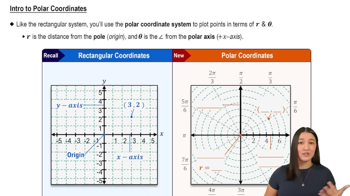
Coordinates and the Terminal Side of an Angle
An angle in standard position has its vertex at the origin and its initial side along the positive x-axis. The given point (6√3, -6) lies on the terminal side of the angle, and its coordinates help determine the radius (distance from origin) and the signs of the trigonometric functions.
추천 영상:
Intro to Polar Coordinates
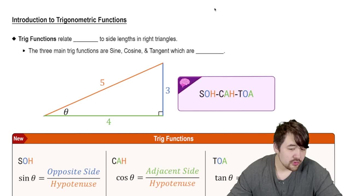
Definition of the Six Trigonometric Functions Using Coordinates
The six trigonometric functions (sine, cosine, tangent, cosecant, secant, cotangent) can be defined using the coordinates (x, y) of a point on the terminal side and the radius r = √(x² + y²). Specifically, sin = y/r, cos = x/r, tan = y/x, and their reciprocals define the other three functions.
추천 영상:
Introduction to Trigonometric Functions
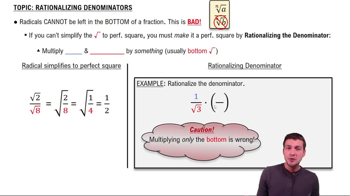
Rationalizing Denominators
When expressing trigonometric functions as fractions, denominators containing radicals should be rationalized for standard form. This involves multiplying numerator and denominator by a suitable radical to eliminate the root from the denominator, ensuring the expression is simplified and easier to interpret.
추천 영상:
가이드 코스
Rationalizing Denominators
관련 실천
교과서 질문
630
views
교과서 질문
Find the measure of the smaller angle formed by the hands of a clock at the following times.
806
views
교과서 질문
Find the measure of each marked angle. See Example 2 complementary angles with measures 9𝓍 + 6 and 3𝓍 degrees
605
views
교과서 질문
The measures of two angles of a triangle are given. Find the measure of the third angle. See Example 2.
17° 41' 13" , 96° 12' 10"
988
views
교과서 질문
Determine the signs of the trigonometric functions of an angle in standard position with the given measure. See Example 2.
178°
863
views
교과서 질문
Concept Check Suppose that the point (x, y) is in the indicated quadrant. Determine whether the given ratio is positive or negative. Recall that r = √(x² + y²) .(Hint: Drawing a sketch may help.) III , y/r
553
views