Ch. 1 - Trigonometric Functions
Lial - Trigonometry 12th Edition
Lial12th EditionTrigonometryISBN: 9780136552161당신이 사용하는 게 아니라요?교과서 변경
2장, 문제 75

Give all six trigonometric function values for each angle θ. Rationalize denominators when applicable. See Examples 5–7.
sin θ = √5/7 , and θ is in quadrant I.

검증된 단계별 안내
1
Recall the six trigonometric functions: sine (sin), cosine (cos), tangent (tan), cosecant (csc), secant (sec), and cotangent (cot). We are given sin \( \theta = \frac{\sqrt{5}}{7} \) and that \( \theta \) is in quadrant I, where all trigonometric functions are positive.
Use the Pythagorean identity to find cos \( \theta \): \( \sin^2 \theta + \cos^2 \theta = 1 \). Substitute \( \sin \theta = \frac{\sqrt{5}}{7} \) to get \( \left( \frac{\sqrt{5}}{7} \right)^2 + \cos^2 \theta = 1 \).
Simplify the equation: \( \frac{5}{49} + \cos^2 \theta = 1 \). Then solve for \( \cos^2 \theta \) by subtracting \( \frac{5}{49} \) from both sides: \( \cos^2 \theta = 1 - \frac{5}{49} \).
Calculate \( \cos \theta \) by taking the positive square root (since \( \theta \) is in quadrant I): \( \cos \theta = \sqrt{1 - \frac{5}{49}} \).
Find the remaining trigonometric functions using the definitions: \( \tan \theta = \frac{\sin \theta}{\cos \theta} \), \( \csc \theta = \frac{1}{\sin \theta} \), \( \sec \theta = \frac{1}{\cos \theta} \), and \( \cot \theta = \frac{1}{\tan \theta} \). Rationalize denominators where necessary.

비슷한 문제에 대한 검증된 영상 답변:

이 영상 해법은 위 문제에 도움이 된다고 튜터들이 추천한 것입니다.
영상 길이:
10m
도움이 되었나요?

주요 개념

질문에 올바르게 답하기 위해 반드시 이해해야 하는 핵심 개념들은 다음과 같습니다.

Definition of the Six Trigonometric Functions

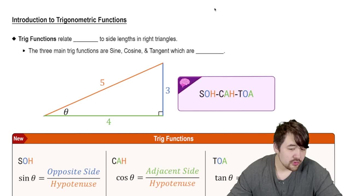
The six trigonometric functions—sine, cosine, tangent, cosecant, secant, and cotangent—are ratios derived from a right triangle or the unit circle. Given sin θ, the other functions can be found using their relationships, such as tan θ = sin θ / cos θ and reciprocal identities like csc θ = 1 / sin θ.
추천 영상:
6:04
Introduction to Trigonometric Functions

Using the Pythagorean Identity to Find Cosine

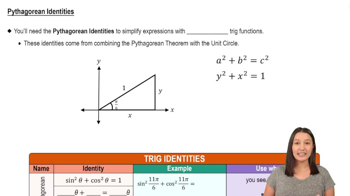
The Pythagorean identity states that sin²θ + cos²θ = 1. Knowing sin θ allows calculation of cos θ by rearranging to cos θ = ±√(1 - sin²θ). The sign depends on the quadrant of θ, which is quadrant I here, so cosine is positive.
추천 영상:
6:25
Pythagorean Identities

Quadrant Sign Rules for Trigonometric Functions

The sign of trigonometric functions depends on the quadrant of the angle. In quadrant I, all six functions are positive. This information is crucial for correctly determining the signs of cosine, tangent, and their reciprocals when calculating their values.
추천 영상:
6:04
Introduction to Trigonometric Functions