Ch. 1 - Trigonometric Functions
Lial - Trigonometry 12th Edition
Lial12th EditionTrigonometryISBN: 9780136552161당신이 사용하는 게 아니라요?교과서 변경
2장, 문제 5

Solve each problem. Rotating Propeller The propeller of a speedboat rotates 650 times per min. Through how many degrees does a point on the edge of the propeller rotate in 2.4 sec?

검증된 단계별 안내
1
Identify the given information: the propeller rotates 650 times per minute, and we want to find the degrees rotated in 2.4 seconds.
Convert the time from seconds to minutes because the rotation rate is given per minute. Use the conversion: \(2.4 \text{ seconds} = \frac{2.4}{60} \text{ minutes}\).
Calculate the number of rotations in 2.4 seconds by multiplying the rotations per minute by the time in minutes: \(\text{rotations} = 650 \times \frac{2.4}{60}\).
Recall that one full rotation corresponds to 360 degrees. To find the total degrees rotated, multiply the number of rotations by 360: \(\text{degrees} = \text{rotations} \times 360\).
Combine all steps to express the total degrees rotated in 2.4 seconds as \(650 \times \frac{2.4}{60} \times 360\), which you can simplify to find the final answer.

비슷한 문제에 대한 검증된 영상 답변:

이 영상 해법은 위 문제에 도움이 된다고 튜터들이 추천한 것입니다.
영상 길이:
2m
도움이 되었나요?

주요 개념

질문에 올바르게 답하기 위해 반드시 이해해야 하는 핵심 개념들은 다음과 같습니다.

Angular Velocity

Angular velocity measures how fast an object rotates, typically expressed in revolutions per minute (rpm) or radians per second. It indicates the number of complete rotations an object makes in a given time, which is essential for converting rotations into angular displacement.
추천 영상:
03:48
Introduction to Vectors

Unit Conversion Between Time and Rotations

To solve rotation problems, it's crucial to convert time units consistently, such as from minutes to seconds, and relate rotations per minute to rotations over a specific time interval. This allows calculation of the total number of rotations in the given time.
추천 영상:
06:11
Introduction to the Unit Circle

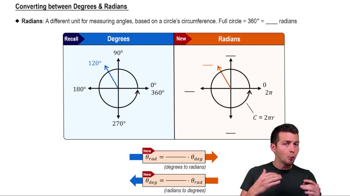
Conversion Between Rotations and Degrees

One full rotation corresponds to 360 degrees. To find the angular displacement in degrees, multiply the number of rotations by 360. This conversion translates rotational motion into angular measurement, which is the problem's required output.
추천 영상:
5:04
Converting between Degrees & Radians