Ch. 1 - Trigonometric Functions
Lial - Trigonometry 12th Edition
Lial12th EditionTrigonometryISBN: 9780136552161당신이 사용하는 게 아니라요?교과서 변경
2장, 문제 96

Use trigonometric function values of quadrantal angles to evaluate each expression. ―3(sin 90°)⁴ + 4(cos 180°)³

검증된 단계별 안내
1
Recall the values of sine and cosine at quadrantal angles: \( \sin 90^\circ = 1 \) and \( \cos 180^\circ = -1 \).
Evaluate \( (\sin 90^\circ)^4 \) by raising \( \sin 90^\circ = 1 \) to the 4th power: \( 1^4 \).
Evaluate \( (\cos 180^\circ)^3 \) by raising \( \cos 180^\circ = -1 \) to the 3rd power: \( (-1)^3 \).
Substitute these values back into the expression: \( -3 \times (1^4) + 4 \times (-1)^3 \).
Simplify the expression step-by-step by performing the multiplications and additions to find the final value.

비슷한 문제에 대한 검증된 영상 답변:

이 영상 해법은 위 문제에 도움이 된다고 튜터들이 추천한 것입니다.
영상 길이:
2m
도움이 되었나요?

주요 개념

질문에 올바르게 답하기 위해 반드시 이해해야 하는 핵심 개념들은 다음과 같습니다.

Quadrantal Angles

Quadrantal angles are angles located on the x- or y-axis in the coordinate plane, specifically 0°, 90°, 180°, 270°, and 360°. Their sine and cosine values are always 0, ±1, which simplifies trigonometric calculations significantly.
추천 영상:
6:36
Quadratic Formula

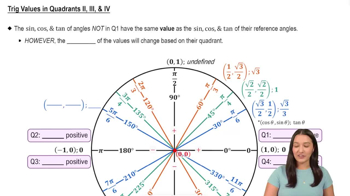
Trigonometric Function Values at Quadrantal Angles

The sine and cosine values at quadrantal angles are fixed: sin 90° = 1, cos 180° = -1, etc. Knowing these exact values allows direct substitution into expressions without approximation, making evaluation straightforward.
추천 영상:
5:30
Trig Values in Quadrants II, III, & IV

Exponentiation of Trigonometric Values

Raising sine or cosine values to powers involves multiplying the value by itself repeatedly. For example, (sin 90°)⁴ means (1)⁴ = 1. Understanding how powers affect ±1 and 0 is crucial for correctly simplifying expressions.
추천 영상:
5:32
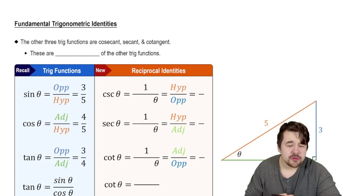
Fundamental Trigonometric Identities