Ch. 2 - Acute Angles and Right Triangles
Lial - Trigonometry 12th Edition
Lial12th EditionTrigonometryISBN: 9780136552161당신이 사용하는 게 아니라요?교과서 변경
3장, 문제 1

CONCEPT PREVIEW Match each trigonometric function value or angle in Column I with its appropriate approximation in Column II.
Column I: 1. sin 83°
Column II: A. 88.09084757°; B. 63.25631605°; C. 1.909152433°; D. 17.45760312°; E. 0.2867453858; F. 1.962610506; G. 14.47751219°; H. 1.015426612; I. 1.051462224; J. 0.9925461516

검증된 단계별 안내
1
Identify the trigonometric function values or angles given in Column I and understand that the goal is to match each with its approximate numerical value or angle from Column II.
Recall that for an angle \( \theta \) in degrees, the sine function value is calculated as \( \sin(\theta) \), which will be a number between -1 and 1, while inverse sine (arcsin) or other inverse functions return angles in degrees or radians.
Calculate or estimate the sine of 83° using a calculator or sine table: \( \sin(83^\circ) \). This will give a decimal value that should match one of the decimal approximations in Column II.
For other entries that are missing in Column I, consider that they might represent inverse trigonometric functions or other trigonometric values. Use the inverse sine, cosine, or tangent functions to find the angle corresponding to the given decimal values in Column II, or vice versa.
Match each value from Column I with the closest approximation in Column II by comparing the calculated or known values, ensuring that angles are matched with angles and function values with function values.

비슷한 문제에 대한 검증된 영상 답변:

이 영상 해법은 위 문제에 도움이 된다고 튜터들이 추천한 것입니다.
영상 길이:
1m
도움이 되었나요?

주요 개념

질문에 올바르게 답하기 위해 반드시 이해해야 하는 핵심 개념들은 다음과 같습니다.

Trigonometric Function Values

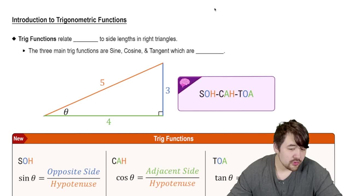
Trigonometric functions like sine, cosine, and tangent relate angles to ratios of sides in right triangles. Understanding how to compute or approximate these values for given angles is essential for matching angles with their function values or vice versa.
추천 영상:
6:04
Introduction to Trigonometric Functions

Inverse Trigonometric Functions

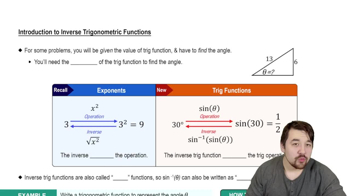
Inverse trig functions (e.g., arcsin, arccos, arctan) allow us to find an angle when given a trigonometric ratio. This concept is crucial for converting function values back into angle measures, which helps in matching values in problems involving approximations.
추천 영상:
4:28
Introduction to Inverse Trig Functions

Degree and Radian Measurement

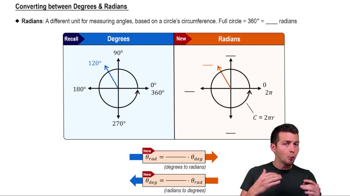
Angles can be measured in degrees or radians, and recognizing the units is important for interpreting and matching values correctly. Converting between these units or understanding their approximate decimal values aids in comparing angles and function outputs.
추천 영상:
5:04
Converting between Degrees & Radians