Ch. 2 - Acute Angles and Right Triangles
Lial - Trigonometry 12th Edition
Lial12th EditionTrigonometryISBN: 9780136552161당신이 사용하는 게 아니라요?교과서 변경
3장, 문제 5

CONCEPT PREVIEW Match each trigonometric function value or angle in Column I with its appropriate approximation in Column II.
Column I: 1.
sin⁻¹ 0.30
Column II:
A. 88.09084757°
B. 63.25631605°
C. 1.909152433°
D. 17.45760312°
E. 0.2867453858
F. 1.962610506
G. 14.47751219°
H. 1.015426612
I. 1.051462224
J. 0.9925461516

검증된 단계별 안내
1
Identify the inverse sine function given: \(\sin^{-1} 0.30\). Recall that \(\sin^{-1} x\) gives the angle whose sine is \(x\), so this corresponds to an angle in degrees or radians.
Calculate or recall the approximate value of \(\sin^{-1} 0.30\) in degrees. This will help match it with one of the angle values in Column II (values with a degree symbol).
Recognize that the other values in Column II without degree symbols are likely radian measures or decimal approximations of trigonometric function values.
Match the angle found from \(\sin^{-1} 0.30\) with the closest angle approximation in Column II, and then use the process of elimination to pair the remaining values in Column I with their corresponding approximations in Column II.
Remember that inverse trigonometric functions return angles, while trigonometric function values are decimals between -1 and 1, so use this knowledge to distinguish between angles and function values when matching.

비슷한 문제에 대한 검증된 영상 답변:

이 영상 해법은 위 문제에 도움이 된다고 튜터들이 추천한 것입니다.
영상 길이:
2m
도움이 되었나요?

주요 개념

질문에 올바르게 답하기 위해 반드시 이해해야 하는 핵심 개념들은 다음과 같습니다.

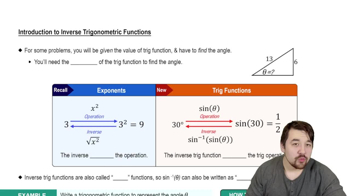
Inverse Trigonometric Functions

Inverse trigonometric functions, such as sin⁻¹ (arcsin), return the angle whose trigonometric ratio equals a given value. For example, sin⁻¹(0.30) gives the angle whose sine is 0.30. Understanding their domain and range is essential for correctly interpreting and matching values to angles.
추천 영상:
4:28
Introduction to Inverse Trig Functions

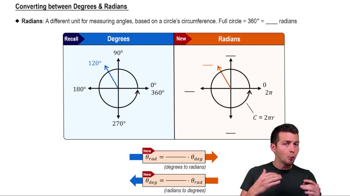
Angle Measurement Units (Degrees and Radians)

Angles can be measured in degrees or radians, two common units in trigonometry. Degrees divide a circle into 360 parts, while radians relate the angle to the radius of a circle. Recognizing and converting between these units is crucial when matching angle approximations with function values.
추천 영상:
5:04
Converting between Degrees & Radians

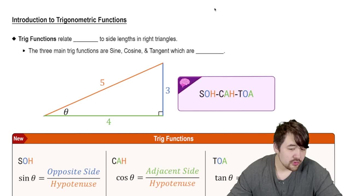
Approximation and Numerical Values of Trigonometric Functions

Trigonometric function values and their inverses often result in decimal approximations. Being able to interpret and compare these numerical values, whether they represent angles or function outputs, helps in correctly pairing values from different columns in matching exercises.
추천 영상:
6:04
Introduction to Trigonometric Functions
관련 실천
교과서 질문

CONCEPT PREVIEW Match each equation in Column I with the appropriate right triangle in Column II. In each case, the goal is to find the value of x.

x = 5 tan 38°

555
views

교과서 질문

CONCEPT PREVIEW Match each trigonometric function value or angle in Column I with its appropriate approximation in Column II.

Column I: 1.

tan 16°

Column II:

A. 88.09084757°

B. 63.25631605°

C. 1.909152433°

D. 17.45760312°

E. 0.2867453858

F. 1.962610506

G. 14.47751219°

H. 1.015426612

I. 1.051462224

J. 0.9925461516

572
views
교과서 질문

CONCEPT PREVIEW Match each trigonometric function in Column I with its value in Column II. Choices may be used once, more than once, or not at all.

csc 60°

646
views
교과서 질문

Concept Check Match each angle in Column I with its reference angle in Column II. Choices may be used once, more than once, or not at all. See Example 1. I. II. 5. A. 45° 6. 212° B. 60° 7. C. 82° 8. D. 30° 9. E. 38° 10. F. 32°

627
views
교과서 질문

CONCEPT PREVIEW Match each trigonometric function value or angle in Column I with its appropriate approximation in Column II.

Column I: 1.

sec 18°

Column II:

A. 88.09084757°

B. 63.25631605°

C. 1.909152433°

D. 17.45760312°

E. 0.2867453858

F. 1.962610506

G. 14.47751219°

H. 1.015426612

I. 1.051462224

J. 0.9925461516

568
views
교과서 질문

CONCEPT PREVIEW Match each trigonometric function value or angle in Column I with its appropriate approximation in Column II.

Column I: 1.

cot 27°

Column II:

A. 88.09084757°

B. 63.25631605°

C. 1.909152433°

D. 17.45760312°

E. 0.2867453858

F. 1.962610506

G. 14.47751219°

H. 1.015426612

I. 1.051462224

J. 0.9925461516

623
views