Ch. 2 - Acute Angles and Right Triangles
Lial - Trigonometry 12th Edition
Lial12th EditionTrigonometryISBN: 9780136552161당신이 사용하는 게 아니라요?교과서 변경
3장, 문제 2.3.30

Find a value of θ in the interval [0°, 90°) that satisfies each statement. Give answers in decimal degrees to six decimal places. See Example 2.
tan θ = 6.4358841

검증된 단계별 안내
1
Understand that the problem asks for an angle \( \theta \) in the interval \( [0^\circ, 90^\circ) \) such that \( \tan \theta = 6.4358841 \). The tangent function relates an angle in a right triangle to the ratio of the opposite side over the adjacent side.
Recall that to find \( \theta \) when given \( \tan \theta \), you use the inverse tangent function (also called arctangent), denoted as \( \tan^{-1} \) or \( \arctan \). This function returns the angle whose tangent is the given value.
Set up the equation: \[ \theta = \tan^{-1}(6.4358841) \]. This will give the angle in degrees if your calculator or software is set to degree mode.
Use a calculator or computational tool to evaluate \( \tan^{-1}(6.4358841) \) and obtain the angle in decimal degrees. Make sure the calculator is in degree mode to get the correct unit.
Since the problem asks for the answer to six decimal places, round the result from the inverse tangent calculation to six decimal places. This will be your value of \( \theta \) in the interval \( [0^\circ, 90^\circ) \).

비슷한 문제에 대한 검증된 영상 답변:

이 영상 해법은 위 문제에 도움이 된다고 튜터들이 추천한 것입니다.
영상 길이:
3m
도움이 되었나요?

주요 개념

질문에 올바르게 답하기 위해 반드시 이해해야 하는 핵심 개념들은 다음과 같습니다.

Tangent Function

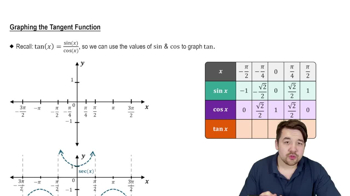
The tangent of an angle in a right triangle is the ratio of the opposite side to the adjacent side. It is also defined as tan θ = sin θ / cos θ. Understanding the tangent function is essential for solving equations involving tan θ, such as finding the angle when the tangent value is given.
추천 영상:
5:43
Introduction to Tangent Graph

Inverse Tangent (Arctan) Function

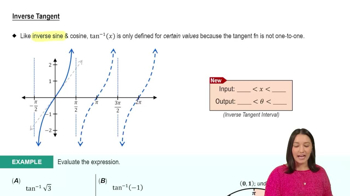
The inverse tangent function, denoted arctan or tan⁻¹, is used to find the angle whose tangent is a given number. It returns an angle typically in the range (-90°, 90°). Using arctan allows us to determine θ when tan θ is known, which is crucial for solving the given problem.
추천 영상:
3:17
Inverse Tangent

Angle Measurement and Interval Restrictions

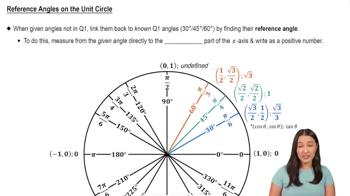
Angles can be measured in degrees or radians, and problems often specify intervals for valid solutions. Here, θ must lie in [0°, 90°), meaning the angle is in the first quadrant where tangent values are positive. Recognizing this interval helps select the correct angle from the inverse tangent output.
추천 영상:
5:31
Reference Angles on the Unit Circle
관련 실천
교과서 질문

Use a calculator to determine whether each statement is true or false. A true statement may lead to results that differ in the last decimal place due to rounding error. cos(30° + 20°) = cos 30° + cos 20°

571
views

교과서 질문

Use a calculator to evaluate each expression. 2 sin 25°13' cos 25°13' - sin 50°26'

675
views
교과서 질문

CONCEPT PREVIEW Match each trigonometric function value or angle in Column I with its appropriate approximation in Column II.


Column I: 1.

csc⁻¹ 4

Column II:

A. 88.09084757°

B. 63.25631605°

C. 1.909152433°

D. 17.45760312°

E. 0.2867453858

F. 1.962610506

G. 14.47751219°

H. 1.015426612

I. 1.051462224

J. 0.9925461516

582
views
교과서 질문

Find a value of θ in the interval [0°, 90°) that satisfies each statement. Give answers in decimal degrees to six decimal places. See Example 2.

csc θ = 1.3861147

697
views
교과서 질문

(Modeling) Length of a Sag Curve When a highway goes downhill and then uphill, it has a sag curve. Sag curves are designed so that at night, headlights shine sufficiently far down the road to allow a safe stopping distance. See the figure. S and L are in feet. The minimum length L of a sag curve is determined by the height h of the car's headlights above the pavement, the downhill grade θ₁ < 0°, the uphill grade θ₂ > 0°, and the safe stopping distance S for a given speed limit. In addition, L is dependent on the vertical alignment of the headlights. Headlights are usually pointed upward at a slight angle α above the horizontal of the car. Using these quantities, for a 55 mph speed limit, L can be modeled by the formula (θ₂ - θ₁)S² L = ————————— , 200(h + S tan α) where S < L. (Data from Mannering, F., and W. Kilareski, Principles of Highway Engineering and Traffic Analysis, Second Edition, John Wiley and Sons.) Compute length L, to the nearest foot, if h = 1.9 ft, α = 0.9°, θ₁ = -3°, θ₂ = 4°, and S = 336 ft.

621
views
교과서 질문

Use a calculator to determine whether each statement is true or false. A true statement may lead to results that differ in the last decimal place due to rounding error. 2 cos 38°22' = cos 76°44'

666
views