
Ch. 2 - Acute Angles and Right Triangles
Lial - Trigonometry 12th Edition
Lial12th EditionTrigonometryISBN: 9780136552161당신이 사용하는 게 아니라요?교과서 변경
3장, 문제 2.3.38

Find a value of θ in the interval [0°, 90°) that satisfies each statement. Give answers in decimal degrees to six decimal places. See Example 2.
cos θ = 0.85536428

검증된 단계별 안내
1
Identify the given equation: \(\cos \theta = 0.85536428\) and the interval for \(\theta\) is \([0^\circ, 90^\circ)\).
Recall that the cosine function is positive and decreasing in the first quadrant, so there will be one solution for \(\theta\) in the given interval.
Use the inverse cosine function to find \(\theta\): \(\theta = \cos^{-1}(0.85536428)\).
Calculate the value of \(\theta\) using a calculator set to degree mode to get the angle in degrees.
Round the result to six decimal places as required.

비슷한 문제에 대한 검증된 영상 답변:

이 영상 해법은 위 문제에 도움이 된다고 튜터들이 추천한 것입니다.
영상 길이:
1m
도움이 되었나요?

주요 개념

질문에 올바르게 답하기 위해 반드시 이해해야 하는 핵심 개념들은 다음과 같습니다.

Cosine Function and Its Properties

The cosine function relates an angle in a right triangle to the ratio of the adjacent side over the hypotenuse. It is periodic and ranges between -1 and 1. Understanding its behavior on the interval [0°, 90°) is essential for finding the angle corresponding to a given cosine value.
추천 영상:
5:53
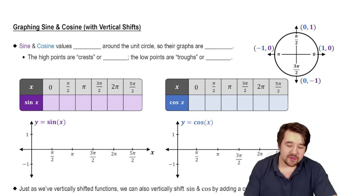
Graph of Sine and Cosine Function

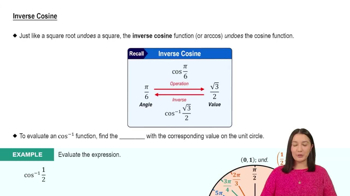
Inverse Cosine (Arccos) Function

The inverse cosine function, denoted arccos or cos⁻¹, returns the angle whose cosine is a given number. It is used to find the angle θ when cos θ is known, typically producing results in the range [0°, 180°]. For this problem, restricting the solution to [0°, 90°) is important.
추천 영상:
4:49
Inverse Cosine

Decimal Degree Precision

Decimal degree precision refers to expressing angles in degrees with decimal points, allowing for more exact measurements. Here, answers must be given to six decimal places, which requires careful calculation and rounding to ensure accuracy.
추천 영상:
5:04
Converting between Degrees & Radians
관련 실천
교과서 질문

(Modeling) Fish's View of the World The figure shows a fish's view of the world above the surface of the water. (Data from Walker, J., 'The Amateur Scientist,' Scientific American.) Suppose that a light ray comes from the horizon, enters the water, and strikes the fish's eye. Assume that this ray gives a value of 90° for angle θ₁ in the formula for Snell's law. (In a practical situation, this angle would probably be a little less than 90°.) The speed of light in water is about 2.254 x 10⁸ m per sec. Find angle θ₂ to the nearest tenth.

606
views
교과서 질문

CONCEPT PREVIEW Match each trigonometric function value or angle in Column I with its appropriate approximation in Column II.


Column I: 1.

cot⁻¹ 30

Column II:

A. 88.09084757°

B. 63.25631605°

C. 1.909152433°

D. 17.45760312°

E. 0.2867453858

F. 1.962610506

G. 14.47751219°

H. 1.015426612

I. 1.051462224

J. 0.9925461516

617
views
교과서 질문

Determine whether each statement is true or false. If false, tell why. Use a calculator for Exercises 39 and 42. 1 tan² 60° = sec² 60°

659
views
교과서 질문

Solve each problem. See Examples 3 and 4. Height of an Antenna A scanner antenna is on top of the center of a house. The angle of elevation from a point 28.0 m from the center of the house to the top of the antenna is 27°10', and the angle of elevation to the bottom of the antenna is 18°10'. Find the height of the antenna.

861
views
교과서 질문

Find two angles in the interval [0°, 360°) that satisfy each of the following. Round answers to the nearest degree. cos θ = 0.10452846

608
views
교과서 질문

Use a calculator to approximate the value of each expression. Give answers to six decimal places. tan 11.7689°

617
views