
Suppose ABC is a right triangle with sides of lengths a, b, and c and right angle at C. Use the Pythagorean theorem to find the unknown side length. Then find exact values of the six trigonometric functions for angle B. Rationalize denominators when applicable. See Example 1. b = 8, c = 11
Ch. 2 - Acute Angles and Right Triangles
3장, 문제 17
Find all values of θ, if θ is in the interval [0°, 360°) and has the given function value. cos θ = -½
검증된 단계별 안내1
Recall that the cosine function corresponds to the x-coordinate on the unit circle for an angle \( \theta \). We are given \( \cos \theta = -\frac{1}{2} \), and we need to find all \( \theta \) in the interval \( [0^\circ, 360^\circ) \) that satisfy this.
Identify the reference angle where \( \cos \theta = \frac{1}{2} \). Since cosine is positive in the first quadrant, find the acute angle \( \alpha \) such that \( \cos \alpha = \frac{1}{2} \). This reference angle \( \alpha \) is \( 60^\circ \) because \( \cos 60^\circ = \frac{1}{2} \).
Since the cosine value is negative, \( \theta \) must lie in the quadrants where cosine is negative. Cosine is negative in the second and third quadrants.
Use the reference angle to find the solutions in the second and third quadrants:
- In the second quadrant, \( \theta = 180^\circ - \alpha \).
- In the third quadrant, \( \theta = 180^\circ + \alpha \).
Write the general solutions explicitly using the reference angle \( 60^\circ \):
- \( \theta = 180^\circ - 60^\circ \)
- \( \theta = 180^\circ + 60^\circ \)
These are the values of \( \theta \) in the interval \( [0^\circ, 360^\circ) \) where \( \cos \theta = -\frac{1}{2} \).

비슷한 문제에 대한 검증된 영상 답변:
이 영상 해법은 위 문제에 도움이 된다고 튜터들이 추천한 것입니다.
영상 길이:
4m도움이 되었나요?
주요 개념
질문에 올바르게 답하기 위해 반드시 이해해야 하는 핵심 개념들은 다음과 같습니다.
Unit Circle and Angle Measurement
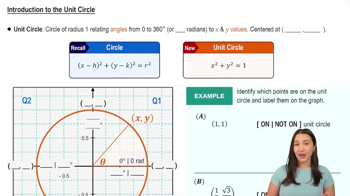
The unit circle is a circle with radius 1 centered at the origin of the coordinate plane. Angles in trigonometry are often measured in degrees or radians on this circle, where the cosine of an angle corresponds to the x-coordinate of the point on the circle. Understanding the unit circle helps identify where cosine values are positive or negative.
추천 영상:
Introduction to the Unit Circle
Cosine Function and Its Values
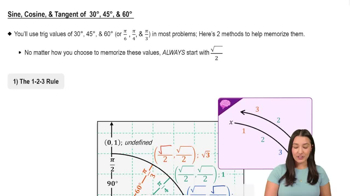
The cosine function relates an angle to the ratio of the adjacent side over the hypotenuse in a right triangle, or equivalently, the x-coordinate on the unit circle. Knowing that cos θ = -½ means finding angles where the x-coordinate is -0.5, which occurs in specific quadrants where cosine is negative.
추천 영상:
Sine, Cosine, & Tangent of 30°, 45°, & 60°
Solving Trigonometric Equations in a Given Interval
To solve cos θ = -½ within [0°, 360°), identify all angles in this range where the cosine equals -½. Since cosine is negative in the second and third quadrants, use reference angles and symmetry properties to find all solutions within the specified interval.
추천 영상:
How to Solve Linear Trigonometric Equations
관련 실천
교과서 질문
872
views
교과서 질문
Find exact values of the six trigonometric functions of each angle. Rationalize denominators when applicable. See Examples 2, 3, and 5. 300°
650
views
교과서 질문
Solve each right triangle. When two sides are given, give angles in degrees and minutes.
512
views
교과서 질문
Find exact values of the six trigonometric functions for each angle. Do not use a calculator. Rationalize denominators when applicable. 120°
744
views
교과서 질문
Solve each right triangle. When two sides are given, give angles in degrees and minutes.
529
views
교과서 질문
Suppose ABC is a right triangle with sides of lengths a, b, and c and right angle at C. Use the Pythagorean theorem to find the unknown side length. Then find exact values of the six trigonometric functions for angle B. Rationalize denominators when applicable. See Example 1. a = √2, c = 2
860
views
