Find one solution for each equation. Assume all angles involved are acute angles. See Example 3. cos(2θ + 50°) = sin(2θ - 20°)
Ch. 2 - Acute Angles and Right Triangles
3장, 문제 40
Find one solution for each equation. Assume all angles involved are acute angles. See Example 3. csc(β + 40°) = sec(β - 20°)
검증된 단계별 안내1
Recall the definitions of the cosecant and secant functions: \(\csc \theta = \frac{1}{\sin \theta}\) and \(\sec \theta = \frac{1}{\cos \theta}\). Rewrite the given equation \(\csc(\beta + 40^\circ) = \sec(\beta - 20^\circ)\) as \(\frac{1}{\sin(\beta + 40^\circ)} = \frac{1}{\cos(\beta - 20^\circ)}\).
Cross-multiply to eliminate the fractions, giving \(\cos(\beta - 20^\circ) = \sin(\beta + 40^\circ)\).
Use the co-function identity \(\sin \theta = \cos(90^\circ - \theta)\) to rewrite the right side: \(\sin(\beta + 40^\circ) = \cos(90^\circ - (\beta + 40^\circ)) = \cos(50^\circ - \beta)\).
Set the two cosine expressions equal: \(\cos(\beta - 20^\circ) = \cos(50^\circ - \beta)\). Recall that if \(\cos A = \cos B\), then either \(A = B\) or \(A = 360^\circ - B\) (or in degrees, \(A = B + 360^\circ k\) or \(A = -B + 360^\circ k\) for integer \(k\)). Since angles are acute, focus on the principal solutions.
Solve the equations \(\beta - 20^\circ = 50^\circ - \beta\) and \(\beta - 20^\circ = -(50^\circ - \beta)\) for \(\beta\), then check which solutions are acute angles (between \(0^\circ\) and \(90^\circ\)).

비슷한 문제에 대한 검증된 영상 답변:
이 영상 해법은 위 문제에 도움이 된다고 튜터들이 추천한 것입니다.
도움이 되었나요?
주요 개념
질문에 올바르게 답하기 위해 반드시 이해해야 하는 핵심 개념들은 다음과 같습니다.
Reciprocal Trigonometric Functions
Cosecant (csc) and secant (sec) are reciprocal functions of sine and cosine, respectively. Specifically, csc(θ) = 1/sin(θ) and sec(θ) = 1/cos(θ). Understanding these relationships allows rewriting the equation in terms of sine and cosine for easier manipulation.
추천 영상:
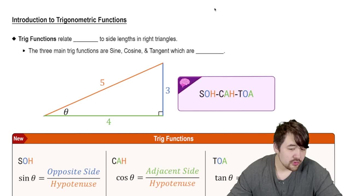
Introduction to Trigonometric Functions
Trigonometric Equation Solving
Solving trigonometric equations often involves rewriting expressions, using identities, and isolating the variable. Here, equating csc(β + 40°) to sec(β - 20°) requires converting to sine and cosine, then finding β that satisfies the resulting equation within the given domain.
추천 영상:
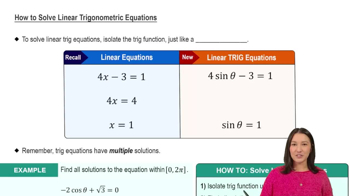
How to Solve Linear Trigonometric Equations
Domain Restrictions and Acute Angles
The problem specifies that all angles are acute, meaning they lie between 0° and 90°. This restriction limits possible solutions and helps in selecting the correct angle values after solving the equation, ensuring the solution is valid within the given context.
추천 영상:
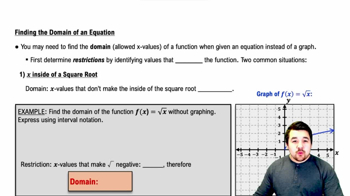
Finding the Domain of an Equation
관련 실천
교과서 질문
585
views
교과서 질문
Find the exact value of each expression. See Example 3. sec(-495°)
597
views
교과서 질문
Determine whether each statement is true or false. See Example 4. tan 28° ≤ tan 40°
575
views
교과서 질문
Find one solution for each equation. Assume all angles involved are acute angles. See Example 3. sec(3β + 10°) = csc(β + 8°)
726
views
교과서 질문
Find the exact value of each expression. See Example 3. tan(-1020°)
597
views
교과서 질문
Solve each right triangle. In each case, C = 90°. If angle information is given in degrees and minutes, give answers in the same way. If angle information is given in decimal degrees, do likewise in answers. When two sides are given, give angles in degrees and minutes. See Examples 1 and 2. B = 39°09', c = 0.6231 m
579
views