Ch. 2 - Acute Angles and Right Triangles
Lial - Trigonometry 12th Edition
Lial12th EditionTrigonometryISBN: 9780136552161당신이 사용하는 게 아니라요?교과서 변경
3장, 문제 22

Write each function in terms of its cofunction. Assume all angles involved are acute angles. See Example 2. sin 45°

검증된 단계별 안내
1
Recall the cofunction identity for sine and cosine: \(\sin(\theta) = \cos(90^\circ - \theta)\) for acute angles.
Identify the given angle \(\theta = 45^\circ\).
Apply the cofunction identity by substituting \(\theta\) with \(45^\circ\): \(\sin(45^\circ) = \cos(90^\circ - 45^\circ)\).
Simplify the expression inside the cosine function: \(90^\circ - 45^\circ = 45^\circ\).
Write the final expression: \(\sin(45^\circ) = \cos(45^\circ)\).

비슷한 문제에 대한 검증된 영상 답변:

이 영상 해법은 위 문제에 도움이 된다고 튜터들이 추천한 것입니다.
영상 길이:
1m
도움이 되었나요?

주요 개념

질문에 올바르게 답하기 위해 반드시 이해해야 하는 핵심 개념들은 다음과 같습니다.

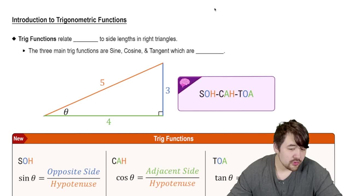
Trigonometric Functions

Trigonometric functions like sine, cosine, tangent, and their reciprocals relate the angles of a right triangle to the ratios of its sides. Understanding these functions is essential for expressing one function in terms of another, especially when dealing with complementary angles.
추천 영상:
6:04
Introduction to Trigonometric Functions

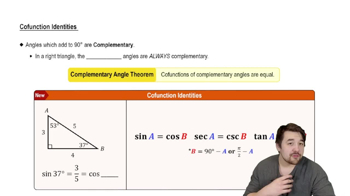
Cofunction Identities

Cofunction identities state that the value of a trigonometric function of an angle equals the value of its cofunction at the complement of that angle. For example, sin(θ) = cos(90° - θ) for acute angles, which allows rewriting functions in terms of their cofunctions.
추천 영상:
6:30
Cofunction Identities

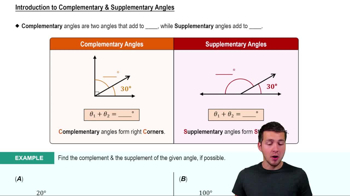
Complementary Angles

Complementary angles are two angles whose measures add up to 90°. In trigonometry, many identities and relationships, including cofunction identities, rely on this concept to connect functions of one angle to functions of its complement.
추천 영상:
3:35
Intro to Complementary & Supplementary Angles