Ch. 3 - Radian Measure and The Unit Circle
Lial - Trigonometry 12th Edition
Lial12th EditionTrigonometryISBN: 9780136552161당신이 사용하는 게 아니라요?교과서 변경
4장, 문제 3.49

Find a calculator approximation to four decimal places for each circular function value.
sec 7.3159

검증된 단계별 안내
1
Understand that the secant function, \( \sec(\theta) \), is the reciprocal of the cosine function, \( \cos(\theta) \). Therefore, \( \sec(\theta) = \frac{1}{\cos(\theta)} \).
Use a calculator to find \( \cos(7.3159) \). Make sure your calculator is set to the correct mode (radians or degrees) based on the context of the problem. Since 7.3159 is a large number, it is likely in radians.
Calculate the reciprocal of the cosine value obtained: \( \sec(7.3159) = \frac{1}{\cos(7.3159)} \).
Use the calculator to find the reciprocal value, ensuring the result is accurate to four decimal places.
Verify the result by checking the calculator settings and recalculating if necessary to ensure the accuracy of the approximation.

비슷한 문제에 대한 검증된 영상 답변:

이 영상 해법은 위 문제에 도움이 된다고 튜터들이 추천한 것입니다.
도움이 되었나요?

주요 개념

질문에 올바르게 답하기 위해 반드시 이해해야 하는 핵심 개념들은 다음과 같습니다.

Circular Functions

Circular functions, also known as trigonometric functions, relate the angles of a circle to the ratios of its sides. The primary circular functions include sine, cosine, tangent, and their reciprocals: cosecant, secant, and cotangent. Understanding these functions is essential for evaluating angles and their corresponding values in various contexts, including calculus and physics.
추천 영상:
5:57
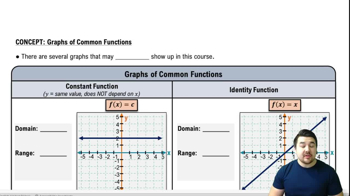
Graphs of Common Functions

Secant Function

The secant function, denoted as sec(θ), is the reciprocal of the cosine function. It is defined as sec(θ) = 1/cos(θ). This function is particularly useful in trigonometry for solving problems involving right triangles and circular motion, and it can be calculated using a calculator for any angle expressed in radians or degrees.
추천 영상:
6:22
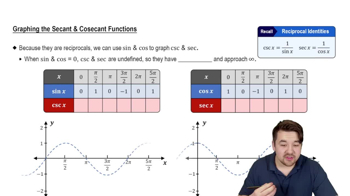
Graphs of Secant and Cosecant Functions

Calculator Approximations

Calculator approximations involve using a scientific or graphing calculator to compute the values of trigonometric functions to a specified degree of accuracy, such as four decimal places. This process typically requires inputting the angle in the correct mode (radians or degrees) and understanding how to read and interpret the output. Mastery of this skill is crucial for accurately solving trigonometric problems in both academic and practical applications.
추천 영상:
4:45
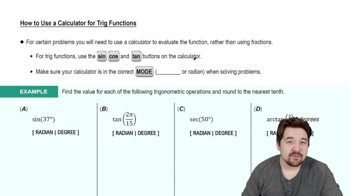
How to Use a Calculator for Trig Functions