Ch. 4 - Graphs of the Circular Functions
Lial - Trigonometry 12th Edition
Lial12th EditionTrigonometryISBN: 9780136552161당신이 사용하는 게 아니라요?교과서 변경
5장, 문제 44

Determine the simplest form of an equation for each graph. Choose b > 0, and include no phase shifts.
<IMAGE>

검증된 단계별 안내
1
Identify the type of trigonometric function represented by the graph (sine or cosine) by observing where the graph starts at x = 0. If it starts at a maximum or minimum, it is likely a cosine function; if it starts at zero and goes upward, it is likely a sine function.
Determine the amplitude (a) by measuring the distance from the midline (usually y = 0) to the maximum or minimum value of the graph. The amplitude is the absolute value of this distance.
Find the period (T) of the function by measuring the length of one complete cycle on the x-axis. Use the formula for the period of sine or cosine: \(T = \frac{2\pi}{b}\), where \(b\) is the frequency parameter you need to find.
Solve for \(b\) using the period: rearrange the formula to \(b = \frac{2\pi}{T}\). Since the problem states \(b > 0\), take the positive value.
Write the equation in the form \(y = a \sin(bx)\) or \(y = a \cos(bx)\) without any phase shifts, using the values of \(a\) and \(b\) found in the previous steps.

비슷한 문제에 대한 검증된 영상 답변:

이 영상 해법은 위 문제에 도움이 된다고 튜터들이 추천한 것입니다.
도움이 되었나요?

주요 개념

질문에 올바르게 답하기 위해 반드시 이해해야 하는 핵심 개념들은 다음과 같습니다.

Basic Form of Trigonometric Functions

Trigonometric functions like sine and cosine are generally expressed as y = a sin(bx + c) + d or y = a cos(bx + c) + d, where 'a' is amplitude, 'b' affects period, 'c' is phase shift, and 'd' is vertical shift. Understanding this form helps in identifying parameters from a graph.
추천 영상:
6:04
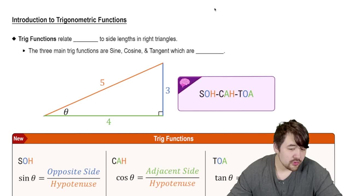
Introduction to Trigonometric Functions

Amplitude and Period

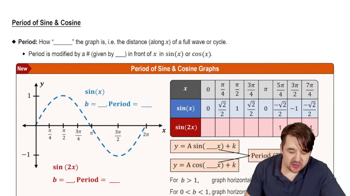
Amplitude is the height from the midline to the peak of the wave, given by |a|, and period is the length of one complete cycle, calculated as 2π/b. Recognizing these from the graph allows determination of 'a' and 'b' values in the equation.
추천 영상:
5:33
Period of Sine and Cosine Functions

Phase Shift and Horizontal Translation

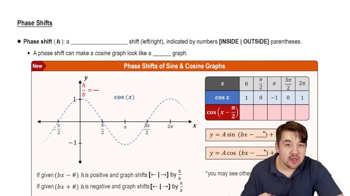
Phase shift represents horizontal shifts of the graph and is given by -c/b in the function y = a sin(bx + c). Since the question specifies no phase shifts, the equation should have c = 0, meaning the graph starts at the standard position without horizontal translation.
추천 영상:
6:31
Phase Shifts