Ch. 4 - Graphs of the Circular Functions
Lial - Trigonometry 12th Edition
Lial12th EditionTrigonometryISBN: 9780136552161당신이 사용하는 게 아니라요?교과서 변경
5장, 문제 29

Each function graphed is of the form y = c + cos x, y = c + sin x, y = cos(x - d), or y = sin(x - d), where d is the least possible positive value. Determine an equation of the graph.


<IMAGE>

검증된 단계별 안내
1
Identify the key features of the graph such as amplitude, vertical shift, and phase shift. Since the functions are of the form \(y = c + \cos x\), \(y = c + \sin x\), \(y = \cos(x - d)\), or \(y = \sin(x - d)\), determine the vertical shift \(c\) by finding the midline of the graph (the average of the maximum and minimum values).
Determine whether the graph resembles a sine or cosine function by looking at the starting point at \(x=0\). If the graph starts at a maximum or minimum, it is likely a cosine function; if it starts at the midline going upward or downward, it is likely a sine function.
Find the period of the function by measuring the distance between two consecutive peaks or troughs. The standard period for sine and cosine is \(2\pi\), so use this to confirm if there is any horizontal stretching or compression.
Calculate the phase shift \(d\) by identifying the horizontal shift from the standard sine or cosine graph. The phase shift is the smallest positive value such that the function matches the graph, and it appears inside the function argument as \(x - d\).
Write the equation by combining the vertical shift \(c\), the function type (sine or cosine), and the phase shift \(d\) into the form \(y = c + \cos(x - d)\) or \(y = c + \sin(x - d)\), using the values you have determined.

비슷한 문제에 대한 검증된 영상 답변:

이 영상 해법은 위 문제에 도움이 된다고 튜터들이 추천한 것입니다.
도움이 되었나요?

주요 개념

질문에 올바르게 답하기 위해 반드시 이해해야 하는 핵심 개념들은 다음과 같습니다.

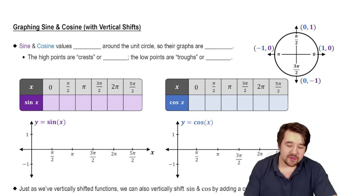
Amplitude and Vertical Shift in Trigonometric Functions

The amplitude of sine and cosine functions determines the height of their peaks and troughs, while the vertical shift (represented by 'c' in y = c + sin x or y = c + cos x) moves the entire graph up or down. Understanding these helps identify the midline and range of the graph.
추천 영상:
5:34
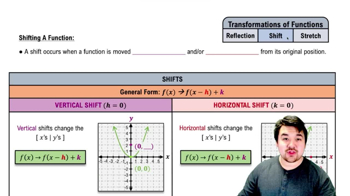
Shifting A Functions

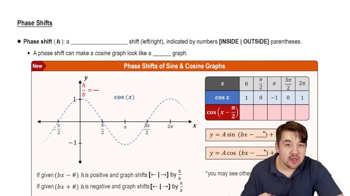
Phase Shift and Horizontal Translation

The phase shift, indicated by 'd' in y = sin(x - d) or y = cos(x - d), represents a horizontal shift of the graph along the x-axis. The least positive value of 'd' moves the graph rightward, changing where the function starts its cycle, which is crucial for matching the graph's position.
추천 영상:
6:31
Phase Shifts

Identifying the Base Function (Sine vs Cosine)

Sine and cosine functions differ in their starting points: cosine starts at a maximum when x=0, while sine starts at zero. Recognizing whether the graph resembles a sine or cosine wave helps determine the correct base function before applying shifts and vertical translations.
추천 영상:
5:53
Graph of Sine and Cosine Function