Ch. 4 - Graphs of the Circular Functions
Lial - Trigonometry 12th Edition
Lial12th EditionTrigonometryISBN: 9780136552161당신이 사용하는 게 아니라요?교과서 변경
5장, 문제 40

Graph each function over a one-period interval.
y = -½ cos (πx - π)

검증된 단계별 안내
1
Identify the given function: \(y = -\frac{1}{2} \cos(\pi x - \pi)\).
Recall that the general form of a cosine function is \(y = A \cos(Bx - C)\), where the period is given by \(\frac{2\pi}{|B|}\).
Calculate the period of the function: since \(B = \pi\), the period is \(\frac{2\pi}{\pi} = 2\).
Determine the one-period interval for \(x\). Since the period is 2, a natural choice is any interval of length 2, for example, \([0, 2]\) or \([-1, 1]\).
Analyze the transformations: the amplitude is \(\frac{1}{2}\) (due to the coefficient \(-\frac{1}{2}\)), the negative sign reflects the graph about the x-axis, and the phase shift is found by solving \(\pi x - \pi = 0\) which gives \(x = 1\). This means the graph is shifted right by 1 unit.

비슷한 문제에 대한 검증된 영상 답변:

이 영상 해법은 위 문제에 도움이 된다고 튜터들이 추천한 것입니다.
도움이 되었나요?

주요 개념

질문에 올바르게 답하기 위해 반드시 이해해야 하는 핵심 개념들은 다음과 같습니다.

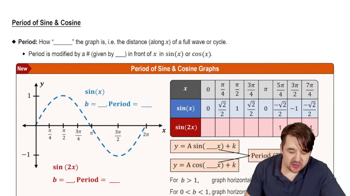
Period of a Trigonometric Function

The period is the length of one complete cycle of a trigonometric function. For cosine functions of the form y = cos(bx), the period is calculated as 2π divided by the absolute value of b. Understanding the period helps determine the interval over which to graph the function.
추천 영상:
5:33
Period of Sine and Cosine Functions

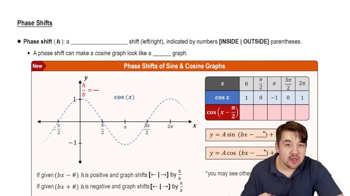
Phase Shift in Trigonometric Functions

Phase shift refers to the horizontal translation of the graph caused by adding or subtracting a constant inside the function's argument. For y = cos(bx - c), the phase shift is c/b. It affects where the graph starts within the period and is essential for accurate plotting.
추천 영상:
6:31
Phase Shifts

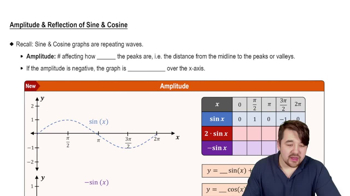
Amplitude and Reflection

Amplitude is the absolute value of the coefficient multiplying the cosine function, indicating the maximum displacement from the midline. A negative coefficient reflects the graph across the x-axis. In y = -½ cos(πx - π), the amplitude is ½, and the negative sign flips the graph vertically.
추천 영상:
5:05
Amplitude and Reflection of Sine and Cosine