Ch. 5 - Trigonometric Identities
Lial - Trigonometry 12th Edition
Lial12th EditionTrigonometryISBN: 9780136552161당신이 사용하는 게 아니라요?교과서 변경
6장, 문제 5.RE.20

For each expression in Column I, use an identity to choose an expression from Column II with the same value. Choices may be used once, more than once, or not at all.
-sin 35°

검증된 단계별 안내
1
Recognize that the expression is \(-\sin 35^\circ\), which is the negative of the sine of 35 degrees.
Recall the identity for sine of a negative angle: \(\sin(-\theta) = -\sin \theta\). This means \(-\sin 35^\circ = \sin(-35^\circ)\).
Also remember the sine co-function identity: \(\sin(180^\circ - \theta) = \sin \theta\). Using this, \(-\sin 35^\circ = \sin(-35^\circ) = \sin(360^\circ - 35^\circ) = \sin 325^\circ\).
Alternatively, use the identity \(\sin(\theta) = -\sin(180^\circ - \theta)\) to rewrite \(-\sin 35^\circ = \sin(180^\circ - 35^\circ) = \sin 145^\circ\).
Therefore, expressions like \(\sin(-35^\circ)\), \(\sin 325^\circ\), or \(\sin 145^\circ\) are equivalent to \(-\sin 35^\circ\) and can be matched accordingly.

비슷한 문제에 대한 검증된 영상 답변:

이 영상 해법은 위 문제에 도움이 된다고 튜터들이 추천한 것입니다.
도움이 되었나요?

주요 개념

질문에 올바르게 답하기 위해 반드시 이해해야 하는 핵심 개념들은 다음과 같습니다.

Trigonometric Identities

Trigonometric identities are equations involving trigonometric functions that hold true for all angle values. They allow the transformation of expressions into equivalent forms, such as converting sine to cosine or using negative angle identities to simplify or match expressions.
추천 영상:
5:32
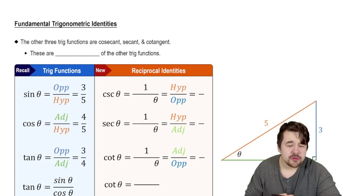
Fundamental Trigonometric Identities

Negative Angle Identities

Negative angle identities relate the trigonometric function of a negative angle to that of a positive angle. For sine, sin(-θ) = -sin(θ), which means -sin(35°) can be rewritten as sin(-35°), helping to find equivalent expressions.
추천 영상:
05:06
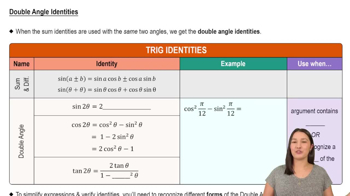
Double Angle Identities

Angle Complement and Supplement Relationships

Sine and cosine functions have relationships based on complementary (90° - θ) and supplementary (180° - θ) angles. For example, sin(θ) = cos(90° - θ), and these relationships help in matching expressions by rewriting angles in different forms.
추천 영상:
3:35
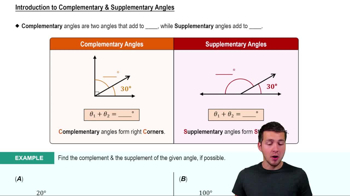
Intro to Complementary & Supplementary Angles