Ch. 5 - Trigonometric Identities
Lial - Trigonometry 12th Edition
Lial12th EditionTrigonometryISBN: 9780136552161당신이 사용하는 게 아니라요?교과서 변경
6장, 문제 46

Write each function as an expression involving functions of θ or x alone. See Example 2.
sin(π + x)

검증된 단계별 안내
1
Recall the angle addition formula for sine: \(\sin(a + b) = \sin a \cos b + \cos a \sin b\).
Apply the formula to \(\sin(\pi + x)\) by letting \(a = \pi\) and \(b = x\), so \(\sin(\pi + x) = \sin \pi \cos x + \cos \pi \sin x\).
Use the known exact values: \(\sin \pi = 0\) and \(\cos \pi = -1\).
Substitute these values back into the expression: \(\sin(\pi + x) = 0 \cdot \cos x + (-1) \cdot \sin x\).
Simplify the expression to get \(\sin(\pi + x) = -\sin x\), which expresses the function in terms of \(x\) alone.

비슷한 문제에 대한 검증된 영상 답변:

이 영상 해법은 위 문제에 도움이 된다고 튜터들이 추천한 것입니다.
도움이 되었나요?

주요 개념

질문에 올바르게 답하기 위해 반드시 이해해야 하는 핵심 개념들은 다음과 같습니다.

Angle Addition Formulas

Angle addition formulas express trigonometric functions of sums or differences of angles in terms of functions of individual angles. For sine, the formula is sin(a + b) = sin(a)cos(b) + cos(a)sin(b). This allows rewriting expressions like sin(π + x) using known values of sine and cosine at π.
추천 영상:
6:36
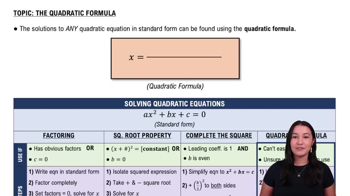
Quadratic Formula

Trigonometric Values at Special Angles

Certain angles, such as π (180°), have well-known sine and cosine values: sin(π) = 0 and cos(π) = -1. These values simplify expressions involving these angles, enabling the reduction of complex expressions like sin(π + x) to simpler forms involving sin(x) and cos(x).
추천 영상:
3:28
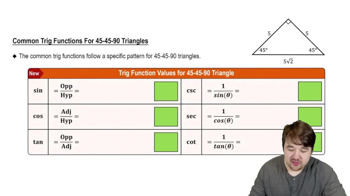
Common Trig Functions For 45-45-90 Triangles

Function Transformation and Periodicity

Trigonometric functions exhibit periodicity and symmetry properties, such as sin(θ + 2π) = sin(θ) and sin(π + x) = -sin(x). Understanding these transformations helps rewrite functions involving shifted angles into equivalent expressions involving the original variable alone.
추천 영상:
4:22
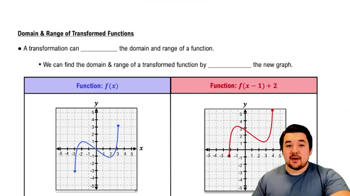
Domain and Range of Function Transformations