Ch. 5 - Trigonometric Identities
Lial - Trigonometry 12th Edition
Lial12th EditionTrigonometryISBN: 9780136552161당신이 사용하는 게 아니라요?교과서 변경
6장, 문제 14

Use a half-angle identity to find each exact value.
cos 195°

검증된 단계별 안내
1
Recognize that 195° is not a standard angle, but it can be expressed in terms of an angle whose cosine value is known. Notice that 195° = 2 × 97.5°, so we can use the half-angle identity for cosine by setting \( \theta = 195° \) and \( \frac{\theta}{2} = 97.5° \). However, since 97.5° is not a standard angle either, let's try expressing 195° as \( 180° + 15° \) to use angle sum identities or consider the half-angle identity for \( 195° = 2 \times 97.5° \) directly.
Recall the half-angle identity for cosine: \[ \cos \left( \frac{\theta}{2} \right) = \pm \sqrt{ \frac{1 + \cos \theta}{2} } \] Since we want \( \cos 195° \), we can rewrite it as \( \cos (2 \times 97.5°) \) and then use the double-angle formula or use the half-angle identity by setting \( \theta = 390° \) (which is \( 2 \times 195° \)) and then find \( \cos 195° = \cos \left( \frac{\theta}{2} \right) \). But this might be complicated, so instead, let's use the half-angle identity by expressing 195° as \( 180° + 15° \) and then use the cosine addition formula or the half-angle identity for 15°.
Alternatively, express 195° as \( 180° + 15° \). Since cosine has the property: \[ \cos (180° + x) = -\cos x \] we can write: \[ \cos 195° = \cos (180° + 15°) = -\cos 15° \] Now, focus on finding \( \cos 15° \) using the half-angle identity.
To find \( \cos 15° \), use the half-angle identity with \( \theta = 30° \) because \( 15° = \frac{30°}{2} \). Apply the half-angle formula: \[ \cos 15° = \cos \left( \frac{30°}{2} \right) = \pm \sqrt{ \frac{1 + \cos 30°}{2} } \] Determine the sign by considering the quadrant of 15°, which is in the first quadrant where cosine is positive.
Substitute the known value \( \cos 30° = \frac{\sqrt{3}}{2} \) into the formula: \[ \cos 15° = \sqrt{ \frac{1 + \frac{\sqrt{3}}{2}}{2} } \] Simplify the expression inside the square root to get the exact value of \( \cos 15° \). Finally, recall from step 3 that \( \cos 195° = -\cos 15° \), so multiply your result by -1 to find the exact value of \( \cos 195° \).

비슷한 문제에 대한 검증된 영상 답변:

이 영상 해법은 위 문제에 도움이 된다고 튜터들이 추천한 것입니다.
도움이 되었나요?

주요 개념

질문에 올바르게 답하기 위해 반드시 이해해야 하는 핵심 개념들은 다음과 같습니다.

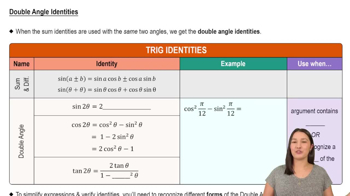
Half-Angle Identities

Half-angle identities express the trigonometric functions of half an angle in terms of the cosine or sine of the original angle. For cosine, the identity is cos(θ/2) = ±√[(1 + cos θ)/2], where the sign depends on the quadrant of θ/2. These identities help find exact values for angles not commonly found on the unit circle.
추천 영상:
05:06
Double Angle Identities

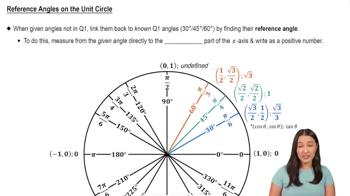
Reference Angles and Quadrants

Understanding the quadrant in which the angle lies is crucial to determine the sign of the trigonometric value. Since 195° is in the third quadrant, and half of 195° is 97.5°, which lies in the second quadrant, the sign of cos(97.5°) is negative. This guides the correct choice of the ± sign in the half-angle formula.
추천 영상:
5:31
Reference Angles on the Unit Circle

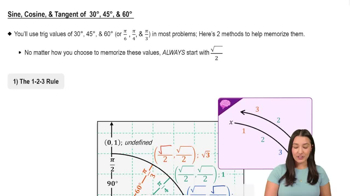
Exact Values of Cosine for Common Angles

To use the half-angle identity, you need the exact cosine value of the original angle, often a multiple of 30°, 45°, or 60°. For 195°, the related angle is 390° (2 × 195°), but since 195° = 360° - 165°, you can use cos 165° = -cos 15°, and cos 15° can be found using sum or difference formulas. Knowing these exact values is essential for precise calculation.
추천 영상:
5:08
Sine, Cosine, & Tangent of 30°, 45°, & 60°