Ch. 5 - Trigonometric Identities
Lial - Trigonometry 12th Edition
Lial12th EditionTrigonometryISBN: 9780136552161당신이 사용하는 게 아니라요?교과서 변경
6장, 문제 52a

Use the given information to find sin(s + t). See Example 3.
sin s = 3/5 and sin t = -12/13, s in quadrant I and t in quadrant III

검증된 단계별 안내
1
Identify the given information: \( \sin s = \frac{3}{5} \) with \( s \) in quadrant I, and \( \sin t = -\frac{12}{13} \) with \( t \) in quadrant III.
Recall the Pythagorean identity to find \( \cos s \) and \( \cos t \). Since \( \sin^2 \theta + \cos^2 \theta = 1 \), calculate \( \cos s = \sqrt{1 - \sin^2 s} \) and \( \cos t = -\sqrt{1 - \sin^2 t} \) (negative because \( t \) is in quadrant III where cosine is negative).
Calculate \( \cos s \) explicitly as \( \cos s = \sqrt{1 - \left(\frac{3}{5}\right)^2} \) and \( \cos t = -\sqrt{1 - \left(-\frac{12}{13}\right)^2} \).
Use the sine addition formula: \( \sin(s + t) = \sin s \cos t + \cos s \sin t \). Substitute the known values of \( \sin s, \cos s, \sin t, \cos t \) into this formula.
Simplify the expression by performing the multiplications and additions to express \( \sin(s + t) \) in terms of fractions, without calculating the final numeric value.

비슷한 문제에 대한 검증된 영상 답변:

이 영상 해법은 위 문제에 도움이 된다고 튜터들이 추천한 것입니다.
도움이 되었나요?

주요 개념

질문에 올바르게 답하기 위해 반드시 이해해야 하는 핵심 개념들은 다음과 같습니다.

Sine and Cosine Values in Different Quadrants

The signs of sine and cosine functions depend on the quadrant of the angle. In quadrant I, both sine and cosine are positive, while in quadrant III, sine and cosine are both negative. This helps determine the correct values of cosine when only sine is given.
추천 영상:
5:08
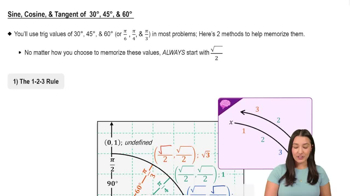
Sine, Cosine, & Tangent of 30°, 45°, & 60°

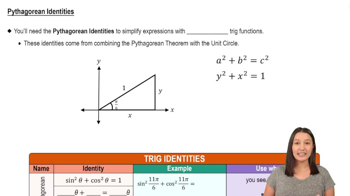
Pythagorean Identity

The Pythagorean identity states that sin²θ + cos²θ = 1 for any angle θ. This allows us to find the cosine value if the sine value is known, by rearranging to cosθ = ±√(1 - sin²θ), with the sign determined by the quadrant.
추천 영상:
6:25
Pythagorean Identities

Sine Addition Formula

The sine addition formula is sin(s + t) = sin s cos t + cos s sin t. It expresses the sine of a sum of two angles in terms of the sines and cosines of the individual angles, enabling calculation of sin(s + t) from known sine and cosine values.
추천 영상:
6:36
Quadratic Formula