Ch. 5 - Trigonometric Identities
Lial - Trigonometry 12th Edition
Lial12th EditionTrigonometryISBN: 9780136552161당신이 사용하는 게 아니라요?교과서 변경
6장, 문제 30

Write each function value in terms of the cofunction of a complementary angle.
sin 98.0142°

검증된 단계별 안내
1
Recall the cofunction identity for sine and cosine: \(\sin(\theta) = \cos(90^\circ - \theta)\), where angles are measured in degrees.
Identify the given angle \(\theta = 98.0142^\circ\) and recognize that the complementary angle to \(\theta\) is \(90^\circ - \theta\).
Calculate the complementary angle: \(90^\circ - 98.0142^\circ = -8.0142^\circ\).
Express \(\sin 98.0142^\circ\) in terms of the cosine of the complementary angle using the identity: \(\sin 98.0142^\circ = \cos(-8.0142^\circ)\).
Recall that cosine is an even function, so \(\cos(-x) = \cos x\), which means \(\sin 98.0142^\circ = \cos 8.0142^\circ\).

비슷한 문제에 대한 검증된 영상 답변:

이 영상 해법은 위 문제에 도움이 된다고 튜터들이 추천한 것입니다.
도움이 되었나요?

주요 개념

질문에 올바르게 답하기 위해 반드시 이해해야 하는 핵심 개념들은 다음과 같습니다.

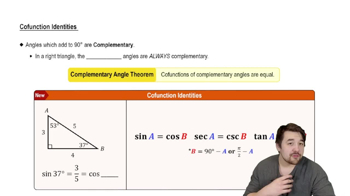
Cofunction Identity

Cofunction identities relate trigonometric functions of complementary angles, where the sum of the angles is 90°. For example, sin(θ) = cos(90° - θ). This allows expressing one function in terms of the cofunction of its complementary angle.
추천 영상:
6:30
Cofunction Identities

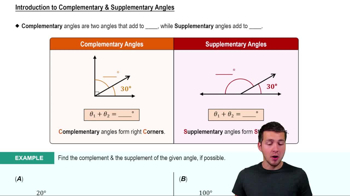
Complementary Angles

Two angles are complementary if their measures add up to 90°. Understanding this is essential because cofunction identities depend on this relationship to convert between sine, cosine, and other trigonometric functions.
추천 영상:
가이드 코스
3:35
Intro to Complementary & Supplementary Angles

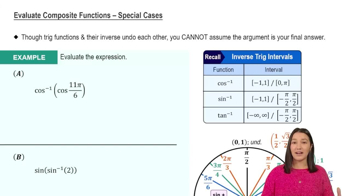
Evaluating Trigonometric Functions at Specific Angles

Evaluating functions like sin 98.0142° involves recognizing that 98.0142° is greater than 90°, so rewriting it using complementary angles and cofunction identities simplifies the expression and aids in calculation or interpretation.
추천 영상:
3:48
Evaluate Composite Functions - Special Cases