Ch. 6 - Inverse Circular Functions and Trigonometric Equations
Lial - Trigonometry 12th Edition
Lial12th EditionTrigonometryISBN: 9780136552161당신이 사용하는 게 아니라요?교과서 변경
7장, 문제 23

Find the exact value of each real number y if it exists. Do not use a calculator.
y = arccos (―√3/2)

검증된 단계별 안내
1
Recall that the function \( y = \arccos(x) \) gives the angle \( y \) in the range \( [0, \pi] \) such that \( \cos(y) = x \). Here, we need to find \( y \) such that \( \cos(y) = -\frac{\sqrt{3}}{2} \).
Identify the reference angle whose cosine value is \( \frac{\sqrt{3}}{2} \). From common trigonometric values, \( \cos\left(\frac{\pi}{6}\right) = \frac{\sqrt{3}}{2} \).
Since the cosine value is negative, determine in which quadrants cosine is negative. Cosine is negative in the second and third quadrants, but \( \arccos \) only returns values in \( [0, \pi] \), which corresponds to the first and second quadrants.
Find the angle in the second quadrant with the same reference angle \( \frac{\pi}{6} \). This angle is \( \pi - \frac{\pi}{6} = \frac{5\pi}{6} \).
Therefore, the exact value of \( y = \arccos\left(-\frac{\sqrt{3}}{2}\right) \) is \( \frac{5\pi}{6} \).

비슷한 문제에 대한 검증된 영상 답변:

이 영상 해법은 위 문제에 도움이 된다고 튜터들이 추천한 것입니다.
도움이 되었나요?

주요 개념

질문에 올바르게 답하기 위해 반드시 이해해야 하는 핵심 개념들은 다음과 같습니다.

Inverse Trigonometric Functions

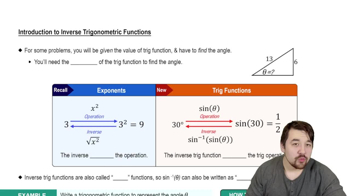
Inverse trigonometric functions, like arccos, return the angle whose trigonometric ratio equals a given value. For arccos(x), it gives the angle y in [0, π] such that cos(y) = x. Understanding their domain and range is essential to find exact angle values.
추천 영상:
4:28
Introduction to Inverse Trig Functions

Exact Values of Cosine for Special Angles

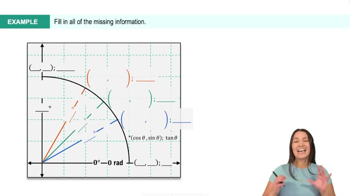
Certain angles have well-known cosine values expressed in terms of square roots, such as cos(π/6) = √3/2 and cos(5π/6) = -√3/2. Recognizing these exact values helps in identifying the angle corresponding to a given cosine value without a calculator.
추천 영상:
6:04
Example 1

Range and Principal Values of arccos

The arccos function outputs principal values in the interval [0, π]. When given a negative cosine value like -√3/2, the corresponding angle must lie within this range, typically in the second quadrant, ensuring the solution is unique and exact.
추천 영상:
4:22
Domain and Range of Function Transformations